
Shoulder Exercises at Home: A Complete Dumbbell and Band Workout

Shoulder workouts at home do not need fifteen versions of the same press or raise. They need a small group of movements that perform different jobs, suit your available equipment, and remain easy to track.
This guide uses dumbbells, a resistance band, a wall, and an optional foam roller. You will prepare the shoulder blades, perform one main press, add two complementary arm paths, and finish with light rotation-control work.
If you already press frequently, account for that workload before adding more. A home chest-training guide that organizes pressing without unnecessarily duplicating shoulder work can help you judge how much additional pressing belongs in the same week.
Quick Answer
Use one low-fatigue preparation movement followed by four working exercises.
| Role | Exercise | Sets | Reps | Rest |
|---|---|---|---|---|
| Shoulder-blade preparation | Serratus Foam Roll Wall Slide | 1–2 | 6–10 | 30 sec |
| Main press | Standing Dumbbell Overhead Press | 2–3 | 6–10 | 60–75 sec |
| Side raise | Standing Dumbbell Lateral Raise | 2 | 10–15 | 45–60 sec |
| Horizontal abduction | Dumbbell Rear Delt Fly | 2 | 10–15 | 45–60 sec |
| Rotation control | Side-Lying Dumbbell External Rotation | 2 | 10–15 each side | 45 sec |
The wall slide prepares movement without exhausting your shoulders. Stop each working set when shrugging, swinging, or trunk movement changes the exercise.
How Many Shoulder Exercises Do You Actually Need?
For this home shoulder workout, four distinct working roles provide a clearer structure than four variations of the same raise.
One exercise supplies a loadable press. One moves the upper arm out to the side. One moves it outward and back. The final movement provides light rotation control. The wall slide is preparation rather than another hard working exercise.
A seated raise can replace a standing raise when you need stricter control. It does not automatically become another exercise. Add a movement only when it solves a different training problem.
Choose Shoulder Exercises by Movement Role
Deltoid exercises are often grouped around the front, side, and back portions of the muscle. Those regions should guide movement selection rather than become three separate lists of nearly identical exercises.
| Movement Role | Default Choice | Why It Stays | Do Not Add Automatically |
|---|---|---|---|
| Vertical press | Standing Dumbbell Overhead Press | Provides measurable resistance and a clear main lift | A second press and a separate front raise |
| Lateral arm raise | Standing Dumbbell Lateral Raise | Adds a direction the press does not fully replace | Seated, lean-away, and band versions together |
| Horizontal abduction | Dumbbell Rear Delt Fly | Moves the upper arm outward and back | Several fly versions plus a face pull |
| Rotation control | Side-Lying Dumbbell External Rotation | Uses light resistance without an anchor | Every internal- and external-rotation variation |
A small EMG study in resistance-trained men found different activation patterns across the shoulder press, lateral raise, bench press, and dumbbell fly. Under the tested conditions, the shoulder press showed the greatest anterior-deltoid activity, while the lateral raise and shoulder press produced more medial-deltoid activity than the two chest exercises.
This supports giving the press and lateral raise different roles, but EMG does not prove long-term growth or validate this exact routine. Review the original deltoid-activation study.
The front of the shoulder already contributes to pressing. The focused guide below explains when additional direct work has a useful role and when it only duplicates existing volume.
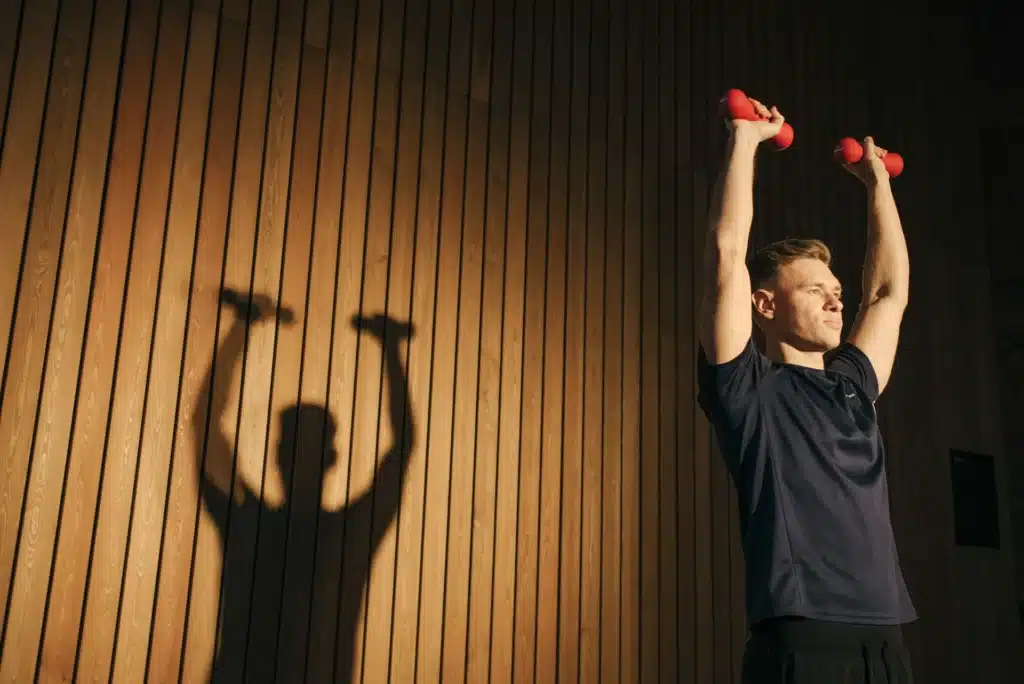
Use these front delt exercises at home only when your front shoulders need extra support. Learn when to train them, when to skip them, and how to avoid overdoing it.
How Should Your Shoulder Blades Move During Shoulder Exercises?
Scapular control does not mean freezing the shoulder blades. They should move smoothly with the arms while the ribs and neck remain controlled.
As your arms rise, the shoulder blades normally rotate upward and tilt posteriorly. Forcing them to remain tightly retracted can restrict overhead movement. Natural movement, however, does not mean uncontrolled shrugging.
During a press or wall slide:
- Keep the ribs from flaring upward.
- Let the shoulder blades follow the arms.
- Keep the neck relaxed.
- Use only the range you can control without leaning backward.
During a fly, avoid turning every repetition into an aggressive shoulder-blade squeeze. The upper arms still need to travel outward and back.
An in-vivo study using bone-fixed sensors in asymptomatic adults found that scapular upward rotation and posterior tilt increased during overhead reaching. Raising and lowering the arm also produced different rhythms.
The study supports coordinated movement, not one fixed ratio for every person or loaded exercise. Read the original scapulohumeral-rhythm study.
A second study of 20 healthy participants found that serratus anterior activity increased with arm elevation during wall slides. This supports using the wall slide as preparation, but it did not test this complete routine. See the wall-slide activation study.
A Quick Three-Step Check
- Wall check: Perform five slow wall slides and watch for rib flare, early shrugging, or one arm stopping much earlier.
- Mirror check: Perform a very light lateral raise and compare both sides without forcing the less-controlled side higher.
- Light-load check: Perform several easy presses. Reduce the load if one shoulder repeatedly rises toward the ear or its dumbbell path changes.
This check does not diagnose abnormal movement. Persistent loss of motion, sudden weakness, or pain needs professional assessment.
For more detailed work on upward rotation, reaching, and left-to-right control, use the dedicated shoulder-blade guide below.
Not feeling your serratus working? Try five serratus anterior exercises with bodyweight, a band, and a dumbbell in this 20-minute home workout.
Choose by Equipment
The dumbbell shoulder exercises in this routine provide measurable loading, while resistance band shoulder exercises allow smaller resistance changes and flexible home setups.
| Training Role | Dumbbell Option | Band Option | Home Setup |
|---|---|---|---|
| Main press | Standing Dumbbell Overhead Press | Standing Band Overhead Press | No bench required |
| Lateral raise | Dumbbell Lateral Raise | Foot-Anchored Band Lateral Raise | Stand on the band |
| Horizontal abduction | Dumbbell Rear Delt Fly | Band Face Pull | Use dumbbells when no secure anchor is available |
| Rotation control | Side-Lying External Rotation | Light Band External Rotation | Side-lying version requires no anchor |
| Preparation | Foam Roll Wall Slide | Single-Arm Band Punch | Use a regular wall slide without a roller |
Choosing Band Resistance
Band colors are not standardized, so judge resistance by movement quality:
- Begin with light tension in the starting position.
- Maintain the listed range without shrugging or shortening the movement.
- Keep the torso, wrist, and shoulder from being pulled out of position.
- Finish with approximately two or three controlled repetitions available.
- Use a lighter band if you cannot control the return.
The correct band maintains tension without changing the intended path. Never attach it to a door, rail, or household object you cannot confirm is stable.
Using One Dumbbell
With one dumbbell, start each unilateral movement on the less-controlled side and match the same clean repetitions on the other. Rest after completing both sides and record them separately when their range or repetitions differ.
For the main press, alternate sides between sets or complete one side followed by the other. Do not add extra repetitions to the weaker side by changing its range or technique.
Combining Dumbbells and a Band
Dumbbells and a band can appear in the same session:
- Dumbbell Overhead Press
- Foot-Anchored Band Lateral Raise
- Dumbbell Rear Delt Fly
- Side-Lying Dumbbell External Rotation
The band raise replaces the dumbbell raise; it is not an additional exercise.
Prepare one moderate dumbbell, one lighter dumbbell, and the band before starting. Complete the standing exercises before moving to the floor to reduce unnecessary setup changes.
For a fuller comparison of standing, seated, lean-away, and band-resisted raises, use the focused guide below.

Try these side delt exercises at home with dumbbells and a band. Build wider-looking shoulders while reducing traps, swinging, and front-delt takeover.
Complete Shoulder Workout at Home
This shoulder workout routine moves from the most loadable exercise to the lightest control task while keeping equipment changes limited.
Three-Minute Preparation
- Easy arm circles: 20 seconds in each direction
- Serratus Foam Roll Wall Slide: 1–2 sets of 6–10 reps
- Light Standing Dumbbell Overhead Press: 1 practice set of 6 reps
Preparation should improve coordination, not create fatigue.
Main Workout
| Exercise | Sets | Reps | Rest | Effort Target | Shoulder-Blade Cue |
|---|---|---|---|---|---|
| Standing Dumbbell Overhead Press | 2–3 | 6–10 | 60–75 sec | Keep about 2 controlled reps available | Let the shoulder blades follow the arms upward |
| Standing Dumbbell Lateral Raise | 2 | 10–15 | 45–60 sec | Stop before shrugging or swinging | Allow natural movement without lifting toward the ears |
| Dumbbell Rear Delt Fly | 2 | 10–15 | 45–60 sec | Stop before it becomes a row | Do not force a hard shoulder-blade squeeze |
| Side-Lying Dumbbell External Rotation | 2 | 10–15 each side | 45 sec | Keep the elbow and torso stable | Keep the shoulder controlled without pulling it backward |
The wall slide rehearses movement before fatigue. The press comes first because it is the most loadable exercise. The raise and fly add different arm paths, and external rotation finishes the session with lighter control work.
Keeping the ribs controlled during pressing also depends on trunk stability. If this is a recurring limitation, use a broader core-training guide that develops trunk control for loaded upper-body movement.
The fly does not replace vertical or horizontal pulling. If those patterns are missing from your week, use a complete home back-training guide that separates pulling roles instead of relying on shoulder isolation work.
For detailed help keeping fly variations out of the neck and upper back, continue with the focused guide below.

Try 3 rear delt exercises at home with dumbbells and a band. Learn how to feel your rear shoulders without turning every rep into traps or rows.
How to Progress Your Shoulder Workout
Progress one variable at a time. More exercises are not a progression method.
| Exercise | First Progression | Next Progression | Do Not Progress When |
|---|---|---|---|
| Overhead Press | Add controlled reps | Add a small load or use one arm | The movement becomes a backbend |
| Lateral Raise | Add a top pause | Add a small load or band tension | The shoulders shrug or arms drift forward |
| Rear Delt Fly | Slow the lowering phase | Add reps, then a small load | The exercise becomes a row or torso swing |
| External Rotation | Add reps and a pause | Add very small resistance | The elbow drifts or torso rotates |
| Wall Slide | Increase smooth range | Add light resistance | The neck tightens or ribs flare |
If the next dumbbell is too heavy, use more clean repetitions, a two- or three-second lowering phase, a pause, or a controlled single-arm version.
Raises may progress more slowly than the main press because a small weight increase represents a larger percentage change. Improve range and control before expecting frequent load increases.
Why Do Shoulder Exercises Feel More in Your Upper Traps?
Some upper-trap involvement is normal. It becomes a problem when shrugging and neck tension drive the movement.
| What You Notice | Check First | First Adjustment |
|---|---|---|
| Neck tightens during raises | Weight and arm direction | Reduce the load and stop chasing extra height |
| You shrug through the press | Rib position and fatigue | Reduce the load and allow natural shoulder-blade movement |
| Fly feels like back training | Elbow path and hard retraction | Move the upper arms outward, not toward the hips |
| External rotation feels like a fly | Load and elbow position | Use a lighter load and stabilize the elbow |
| One side is less controlled | Range and repetition quality | Start there and match the same clean volume |
| Band is slack at the start | Band length and stance | Add light pretension |
Side-lying external rotation produced high infraspinatus and teres-minor activity in an intramuscular EMG study of healthy participants. This supports its role as a light control movement, not a treatment for instability or pain. Read the original external-rotation study.
For a fuller explanation of internal and external rotation roles, arm positions, and band setup, use the dedicated control guide below.

Try these rotator cuff exercises at home with light dumbbells and bands. Train scaption, external rotation, internal rotation, and shoulder control.
Shorten or Adjust the Workout
10-Minute Minimum Session
Keep:
- Wall Slide: 1 set
- Overhead Press: 2 sets
- Lateral Raise: 2 sets
- Rear Delt Fly or Side-Lying External Rotation: 2 sets
Alternate the final movement between sessions. Do not remove every rest period merely to finish faster.
Bad-Day Adjustment
When generally tired but without unusual symptoms:
- Remove one set from each exercise.
- Use a lighter load.
- Keep two or three controlled repetitions available.
- Reduce the range if control is worse.
- End the session if technique continues to deteriorate.
For a recovery-focused day, choose a few low-fatigue wall slides and light rotation work or take complete rest. Do not turn control drills into another hard session.
Direct arm work adds another recovery demand. Organize it through an arm-training guide that fits focused work around compound upper-body training instead of treating every section independently.
Safety and Stop Rules
Use stable supports, inspect bands before every session, and keep the training area clear.
Stop if you experience sharp or increasing pain, numbness, pain travelling down the arm, sudden weakness, a slipping sensation, or symptoms that worsen after stopping.
This guide is for general strength training in healthy adults. It is not a diagnosis, rehabilitation plan, or post-surgery protocol.
Frequently Asked Questions
What Are the Most Effective Shoulder Exercises?
The best shoulder exercises perform different jobs. Use a loadable press, lateral raise, horizontal-abduction movement, and light rotation-control exercise, with a wall slide for preparation.
How Many Shoulder Exercises Should I Do?
Four working exercises are enough for this routine because each has a different role. Add another only when it fills a missing role.
Can I Combine Dumbbells and Resistance Bands?
Yes. Use dumbbells for measurable loading and bands for smaller resistance changes. Replace equivalent versions rather than performing both.
Do I Need a Bench?
No. The default movements use standing, hinged, wall-based, and floor positions.
Should I Keep My Shoulder Blades Down and Back?
Not during every exercise. Let them contribute as the arms rise while avoiding uncontrolled shrugging, rib flare, and momentum.
Does Soreness Mean the Workout Worked?
No. Track exercise version, resistance, repetitions, range, and control instead.
How Often Should I Use This Routine?
Start with one or two weekly sessions and leave at least one full recovery day between demanding sessions.
Train again when daily movement feels comfortable, the preparation set remains controlled, and you can use your planned range. Reduce or delay the session when fatigue changes your normal movement or technique.
Sharp pain, numbness, sudden weakness, or persistent loss of motion requires assessment rather than another workout adjustment.
Conclusion
A complete shoulder workout does not require every press, raise, fly, and band drill. It requires a few movements with clearly separated roles.
Prepare the shoulder blades, perform one main press, add lateral and backward arm paths, then finish with light rotation control. Record the version and resistance you can control, and change only one variable at a time.
Use this routine within a broader upper-body training structure that balances shoulder work with chest, back, arm, and trunk training rather than treating the shoulders as an isolated weekly system.
Medical disclaimer: This article is intended for educational and informational purposes only. It is not intended as a substitute for medical advice. For health advice, contact a licensed healthcare provider.