
Chest Exercises at Home: How to Choose and Build a Workout
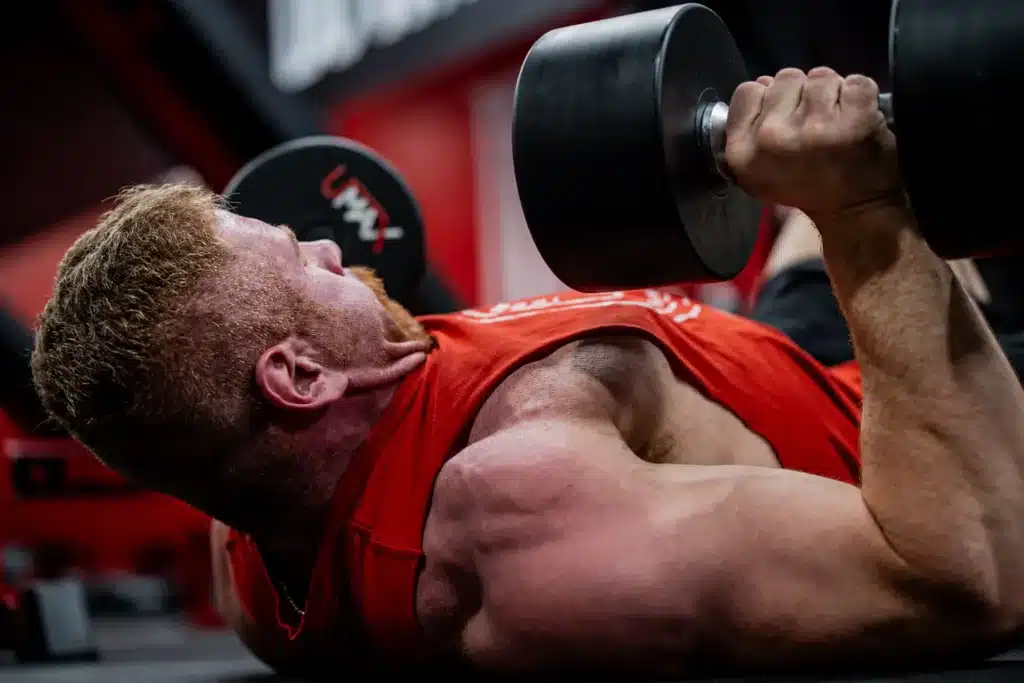
A useful chest workout does not depend on collecting every push-up, press, and fly variation. What matters is choosing a few movements that suit your ability and equipment, then progressing them without letting your shoulders or triceps take over.
This guide combines bodyweight exercises, dumbbells, resistance bands, and stable household supports into a repeatable routine. It sits within the broader upper-body workout guide, where you can also plan the pulling work needed to balance your pressing.
If your current program contains plenty of chest work but very little pulling, use a back-training guide organized around rows and pulling patterns to build a more balanced upper-body schedule.
Quick Answer
Choose two main chest exercises and, when useful, one assistance movement:
- A stable press, such as the Dumbbell Floor Press
- One Push-Up variation matched to your current ability
- An optional Band Fly or Dumbbell Squeeze Press
Perform the main exercises for 2–3 sets and the assistance movement for 2 sets. Stop each set with approximately 2–3 controlled repetitions still available.
Train the routine once or twice per week. Progress the movements you already use before adding more exercises.
How to Choose Chest Exercises
The best chest exercises are the ones you can perform through a controlled range, repeat consistently, and make harder over time.
Each movement in the routine should have a clear role.
| Movement Slot | Purpose | Recommended Exercise | Alternative |
|---|---|---|---|
| Stable press | Provides measurable bilateral loading | Dumbbell Floor Press | Resistance-Band Chest Press |
| Push-up | Develops body control and scalable pressing strength | One suitable Push-Up variation | Hands-Elevated Push-Up for beginners |
| Optional assistance | Adds controlled inward tension without another demanding compound exercise | Single-Arm Resistance-Band Chest Fly | Two-Handed Dumbbell Squeeze Press |
Most people need only two or three chest exercises in one session. Two well-chosen movements can form a minimum workout. A third is useful when it adds a different function instead of repeating the same pressing pattern.
Choose a Chest Training Emphasis
The pectoralis major is one muscle with differently oriented fibers, not a collection of independent “upper,” “lower,” “inner,” and “outer” chest muscles.
Upper and lower chest describe useful changes in pressing angle and regional emphasis. Inner and outer chest are common search terms for exercise selection and body awareness, not separate anatomical muscles. This distinction is consistent with the anatomical description of the pectoral region.
| Training Emphasis | General Approach | Example Movements | Use the Detailed Guide When |
|---|---|---|---|
| Upper chest | Use an elevated pressing path or move the arms upward and inward | Decline Push-Up, Low-to-High Band Fly, Reverse-Grip Dumbbell Floor Press | You want several upper-chest options and a complete regional routine |
| Lower chest | Use a downward pressing or high-to-low fly path | Hands-Elevated Push-Up, Chest Dip, High-to-Low Band Fly | You need dip alternatives, equipment choices, or lower-chest programming |
| Inner-chest intent | Emphasize controlled horizontal adduction and a deliberate inward finish | Band Chest Fly, Ring Squeeze Push-Up, Dumbbell Squeeze Press | You want detailed squeezing cues without treating the inner chest as a separate muscle |
| Outer-chest intent | Use a stable hand position and a controlled, comfortable stretch | Deficit Push-Up, Controlled Wide Push-Up, Dumbbell Floor Press | You need help selecting range, hand width, or progression |
A study involving 30 trained adults compared bench-press muscle activity at five inclinations. Changing the angle affected the distribution of activity across the pectoralis major and anterior deltoid.
The findings support adjusting the pressing angle when you want to change the emphasis. However, the study did not test long-term muscle growth, home push-ups, or this exact routine. View the bench-angle study.
For a routine built around elevated pressing paths and upper-pectoral emphasis, use the guide below.
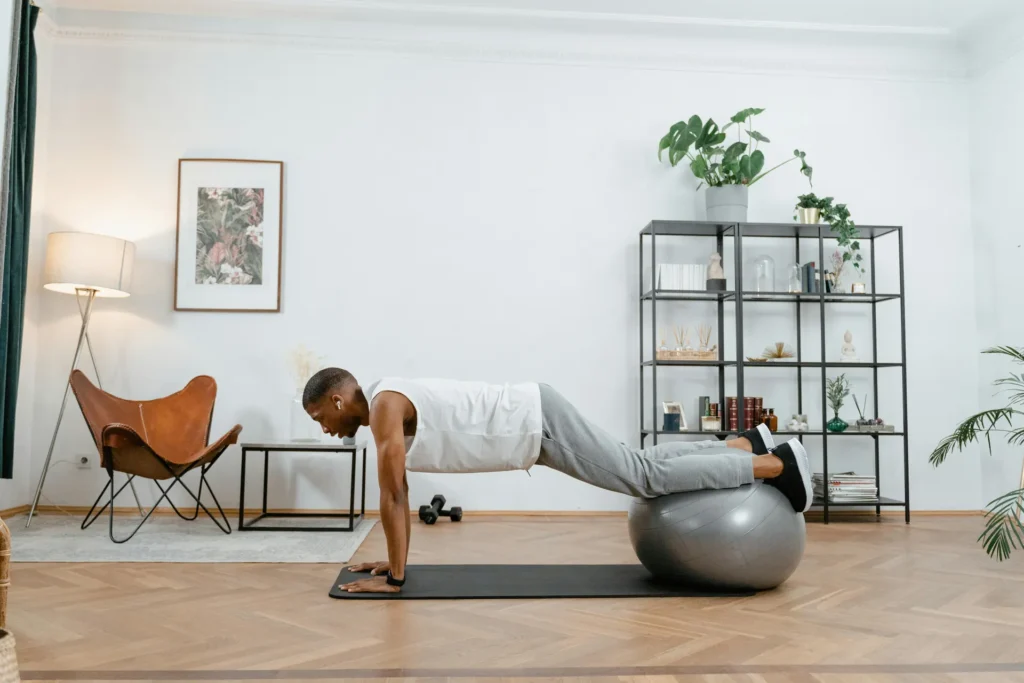
Front delts taking over? Try this 20-minute upper chest workout at home with five push-up, ring, dumbbell, and band exercises—no incline bench needed.
Choose Exercises for Your Equipment
You do not need every tool listed below. Start with the column that matches what you already have.
| Equipment Available | Main Press | Push-Up Option | Optional Assistance |
|---|---|---|---|
| Dumbbells and a floor | Dumbbell Floor Press | Standard or Hands-Elevated Push-Up | Two-Handed Dumbbell Squeeze Press |
| Resistance band | Resistance-Band Chest Press | Standard or Band-Resisted Push-Up | Single-Arm Band Chest Fly |
| Dumbbells and band | Dumbbell Floor Press | Push-Up matched to your level | Band Fly or Dumbbell Squeeze Press |
| Stable elevated surface | Push-Up Variation | Hands-Elevated or Decline Push-Up | Optional band or dumbbell movement |
| Parallel bars | Dumbbell or Band Press | Push-Up Variation | Controlled Chest Dip for suitable trainees |
A chest workout with dumbbells and resistance bands does not require both tools in every movement. One simple approach is to use dumbbells for the stable press and the band for the assistance exercise.
You can also combine resistance bands with dumbbells in the same session, provided each tool has a separate role. Avoid adding band resistance to a dumbbell movement until you can control the original version and secure the band safely.
Push-ups also require trunk control. If your hips sag or your ribs flare before your chest becomes tired, use an abs and trunk-training guide focused on bracing and body-position control alongside your pressing practice.
What If You Do Not Have a Bench?
Use a Dumbbell Floor Press instead of improvising with unstable furniture. The floor limits the bottom position and gives you a consistent setup.
To change the push-up angle, use a secure countertop, heavy table, or stable platform. Test the support before every set.
A bench expands your exercise options, but you do not need one to begin training your chest at home.
For downward pressing paths, dip alternatives, and a complete lower-chest session, continue with the guide below.
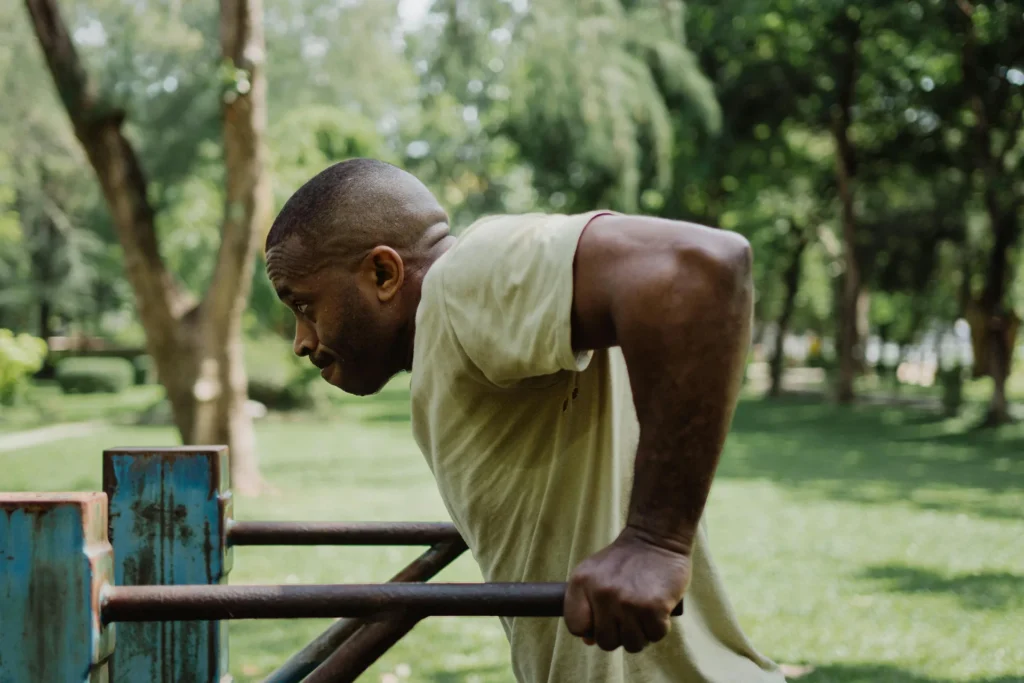
Shoulders and triceps taking over? Try this 20-minute lower chest workout at home using incline push-ups, dips, dumbbells, and a resistance band.
Complete 20–25-Minute Chest Workout
For a beginner chest workout, begin with the easier option in each row. Keep the same versions for several sessions so you can compare your repetitions and technique.
| Order | Exercise | Sets | Reps | Rest | Effort Target | Easier Option |
|---|---|---|---|---|---|---|
| 1 | Dumbbell Floor Press | 2–3 | 8–12 | 60–75 sec | Finish with 2–3 controlled reps available | Use lighter dumbbells |
| 2 | Choose one Push-Up variation | 2–3 | 6–12 | 60–75 sec | Stop before range or body position changes | Hands-Elevated Push-Up |
| 3 |
Single-Arm Band Chest Fly or Two-Handed Dumbbell Squeeze Press |
2 |
Fly: 10–15 each side; Press: 8–15 |
45–60 sec | Use a controlled range without shoulder discomfort | Reduce resistance or omit |
The full routine contains 6–8 working sets. If you have limited time or recovery, perform two sets each of the Floor Press and Push-Up for a four-set minimum session.
Complete the exercises in the listed order.
The stable press comes first because its load is easy to record. The Push-Up follows as the main bodyweight pattern. Assistance work comes last because it needs less resistance and should not reduce the quality of the first two exercises.
Train the routine once or twice per week. Leave enough time between demanding pressing sessions for your normal performance to return.
A five-week study involving 30 resistance-trained university students found similar strength improvements from a band-resisted push-up and a bench press when the resistance was matched around a six-repetition maximum.
The study supports the push-up as a legitimate resistance exercise under comparable conditions. It did not test beginners, muscle growth, or this exact routine. View the push-up comparison study.
Choose One Push-Up Variation
Do not perform every variation in the same workout. Choose one that allows at least six controlled repetitions without shortening the range or losing body position.
| Current Ability or Goal | Recommended Variation | Progression |
|---|---|---|
| Standard Push-Ups are not yet controlled | Hands-Elevated Push-Up | Gradually lower the support |
| Standard Push-Ups are challenging | Standard Push-Up | Add repetitions |
| Standard Push-Ups are easy | Decline Push-Up | Add height gradually |
| You need more controlled range | Deficit Push-Up | Increase depth only while the shoulders remain comfortable |
| You own a suitable band | Band-Resisted Push-Up | Increase band tension gradually |
| You need a harder unilateral challenge | Archer Push-Up | Progress toward a deeper assisted side |
| You have stable parallel bars and adequate control | Chest Dip | Add range or load gradually |
Use only your current variation in the routine. Switching versions every session makes it difficult to tell whether you are actually progressing.
Choose One Assistance Movement
Use a Single-Arm Resistance-Band Chest Fly when you have a safe anchor and want adjustable resistance.
Match the band path to the intended emphasis:
- Mid-height for general horizontal adduction
- Low-to-high for upper-chest emphasis
- High-to-low for lower-chest emphasis
- A crossed-arm finish only when the shoulder remains comfortable
Inspect the band and secure the anchor before every set. If you do not have a suitable anchor, use an anchor-free band press or choose the Dumbbell Squeeze Press.
For the Two-Handed Dumbbell Squeeze Press, either hold one dumbbell securely with both hands or press two dumbbells together. Maintain inward pressure as you press above the chest, but choose a weight you can position safely.
A systematic review covering eight studies found that elastic resistance can produce strength improvements comparable to conventional resistance across varied populations and training protocols.
This supports resistance bands as a usable loading tool. It does not prove that one band exercise or this routine is superior. View the elastic-resistance review.
For detailed exercise cues built around inward tension and the common “inner chest” search intent, use the guide below.

Doing more push-ups but still not seeing a clearer chest line? This inner chest workout uses 5 at-home moves to train a stronger midline squeeze and better pec control.
How to Progress
Progress only when the current version remains controlled through the prescribed range.
| Step | What to Change | Example |
|---|---|---|
| 1 | Reach the lower end of the rep range | Move from 6 to 8 controlled Push-Ups |
| 2 | Add repetitions within the range | Progress from 8 to 12 reps |
| 3 | Repeat the top end with consistent form | Complete 12 reps across all prescribed sets |
| 4 | Increase range or use a harder variation | Lower the support for Hands-Elevated Push-Ups |
| 5 | Add resistance | Use a heavier dumbbell or stronger band |
| 6 | Add one set only if recovery remains stable | Move one main exercise from 2 to 3 sets |
Change one main variable at a time. Adding load, sets, and a harder exercise simultaneously makes it difficult to identify what caused progress or excessive fatigue.
If Push-Ups are too easy, first make sure you are using a consistent range and controlled lowering. Then choose a harder variation, add a backpack, or use a resistance band.
If your dumbbells are too light, add repetitions within the stated range, slow the lowering phase, or use a version with less assistance. Avoid turning every set into very high repetitions when a harder movement or band is available.
Record the exercise version, resistance, completed repetitions, and any clear left-to-right difference.
The ACSM progression model supports gradual changes in volume and intensity. It also generally places multi-joint exercises before smaller assistance movements, although it does not validate this exact routine. View the ACSM progression model.
For detailed range, hand-position, and loading options associated with the common “outer chest” search intent, continue below.
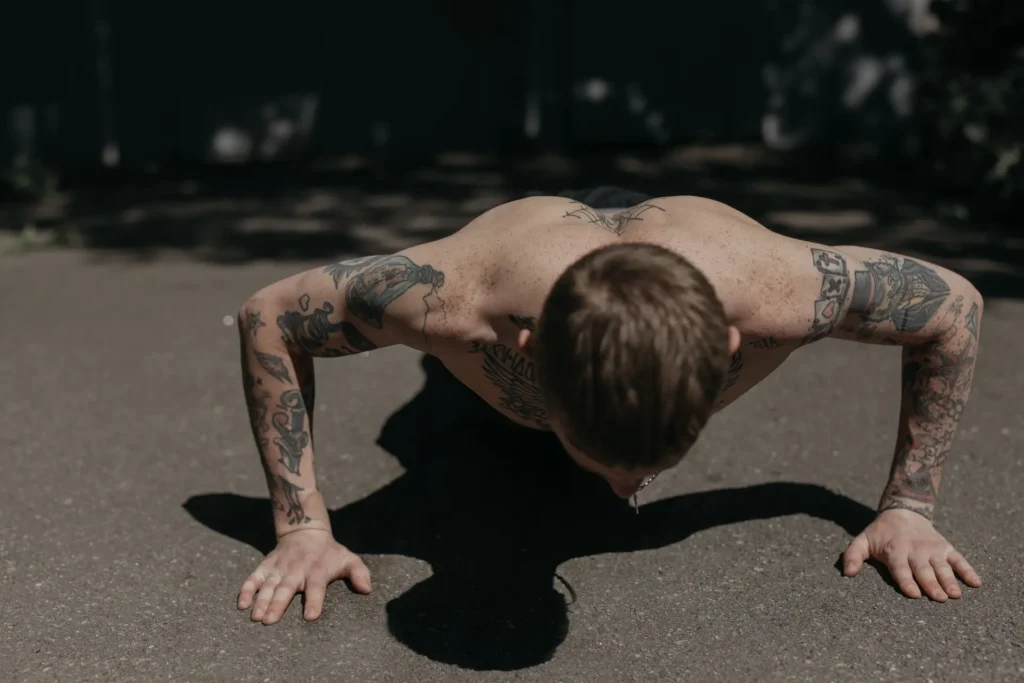
Try this outer chest workout at home with five controlled push-up, band, and dumbbell exercises. Build pec thickness with a practical 20-minute routine.
Troubleshooting Your Chest Workout
I Feel Push-Ups in My Shoulders or Triceps
Some shoulder and triceps involvement is normal. If either area consistently ends the set before your chest:
- Use a higher hand position or an easier variation.
- Keep your elbows at a comfortable angle instead of forcing them outward.
- Maintain a stable shoulder-blade position without excessive shrugging.
- Reduce the range if the bottom position causes pinching or loss of control.
- End the set when your technique changes instead of chasing extra repetitions.
If shoulder position remains the main limitation, use a shoulder-training guide covering pressing and shoulder-blade control separately.
Persistent or sharp pain should not be treated as a normal training sensation.
I Do Not Feel the Exercise in My Chest
Sensation alone does not tell you whether an exercise is effective. First check whether the movement is progressing and whether you can maintain a controlled range.
If your performance is not improving, reduce the difficulty, slow the lowering phase, and choose a version that lets you maintain the same path across every repetition.
Do not keep adding exercises simply to create a stronger pump. Muscle soreness is not required either. Repetitions, resistance, range, and technique are more useful records than how sore you feel after training.
My Resistance Band Feels Ineffective
Check the setup before replacing the movement:
- Start with light tension instead of a completely slack band.
- Use a path that matches the intended press or fly direction.
- Step farther from the anchor only while the setup remains stable.
- Avoid twisting your torso to finish the repetition.
- Use an anchor-free variation if you cannot secure the anchor safely.
Adjust the Workout to Your Day
For a minimum session, complete two sets of Dumbbell Floor Press and two sets of your selected Push-Up. Keep the normal rest periods instead of rushing through four low-quality sets.
On a low-energy day, remove one set or use an easier variation while preserving the exercise order. Stop if your technique continues to deteriorate after the adjustment.
If your triceps are already tired from another session, avoid adding more pressing volume. Use an arm-training guide covering biceps, triceps, and forearms to place direct arm work where it will not repeatedly interfere with the main chest exercises.
Safety and Stop Rules
Use stable, non-slip supports. Inspect bands, anchors, and dumbbells before training, and begin with resistance you can position without assistance.
Stop the exercise if you experience sharp pain, sudden weakness, numbness, loss of control, or a sensation that clearly differs from normal muscular effort.
Do not use this general routine to diagnose or rehabilitate an injury.
Frequently Asked Questions
What are the best chest exercises at home?
A strong starting combination is the Dumbbell Floor Press and one Push-Up variation. Add a Band Chest Fly or Dumbbell Squeeze Press only when it provides a useful assistance pattern.
Are four chest exercises enough for chest day?
Yes. In many cases, four are more than necessary. This routine uses two main movements and one optional assistance exercise so each movement can receive enough controlled work.
Can I build my chest with Push-Ups?
Push-ups can provide meaningful resistance when the variation is challenging and progressively loaded. Increase repetitions, range, elevation, backpack load, or band resistance as the current version becomes easier.
Can I combine resistance bands with dumbbells?
Yes. Use dumbbells for a stable press and the band for a fly or a press from another angle. Keep their roles clear and avoid making both movements harder at the same time.
How often should I train my chest?
Start with one or two weekly sessions. Leave enough time between demanding sessions for your repetitions, control, and range to return.
Do I need a bench?
No. A Floor Press, stable elevated Push-Up, and safely anchored band exercise cover the main roles in this routine. A bench expands your choices but is not required.
Build a Routine You Can Repeat
A complete home chest workout does not need a long exercise list.
Choose a stable press, one suitable Push-Up, and an optional assistance movement. Record your performance, progress one variable at a time, and keep the structure long enough to judge whether it works.
The regional guides can then help you adjust the angle, range, or equipment without replacing the underlying system.
Medical disclaimer: This article is intended for educational and informational purposes only. It is not intended as a substitute for medical advice. For health advice, contact a licensed healthcare provider.