
The “upper chest” is not a separate muscle. The term usually refers to the clavicular head of the pectoralis major, which runs from the collarbone toward the upper arm.
A useful clavicular head workout needs an arm path that travels forward and slightly upward. It should not become a nearly vertical press dominated by the front delts.
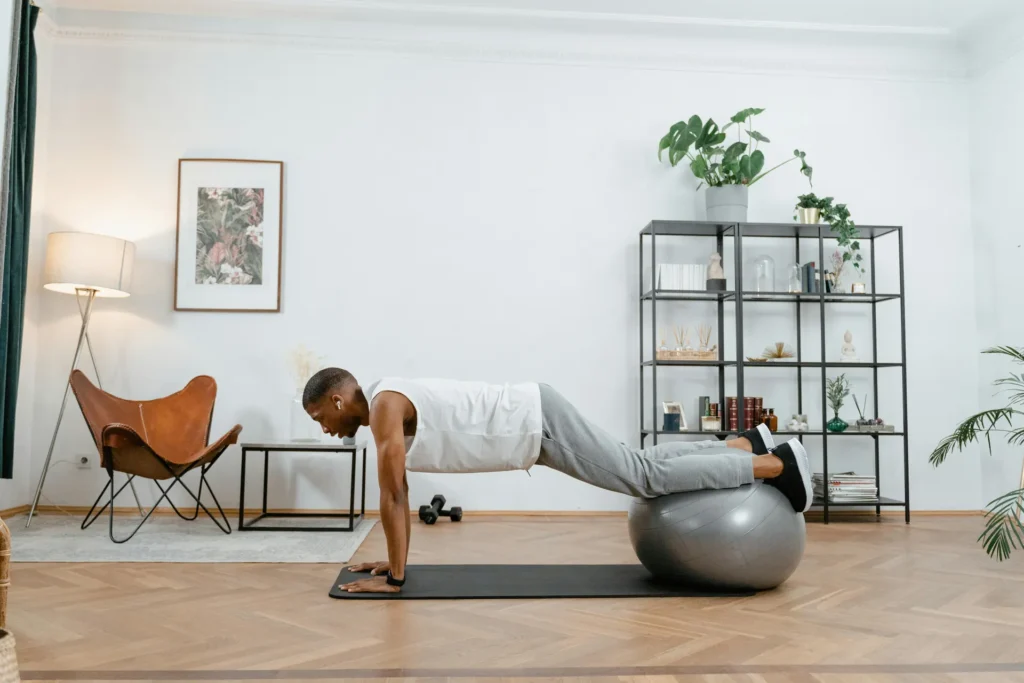
A modest amount of foot elevation can create that path during a push-up. More elevation, however, is not always better. If the hips rise, the chest stops descending between the hands, or the front delts fail before the pecs, the angle is probably too steep for the user’s current strength and control.
The same test applies to clavicular head exercises performed with rings, dumbbells, or resistance bands. Effective exercises for clavicular head development preserve three things: chest tension, a controlled range of motion, and a path the shoulders can tolerate.
Research comparing five bench angles found that steeper inclines progressively increased anterior-deltoid involvement. This supports using enough angle to emphasize the upper chest without turning the movement into a shoulder-dominant press.
Source: Effect of Five Bench Inclinations on Muscle Activity – PubMed
Video:Kevin Harvey
Muscles worked: Pectoralis major with greater upper-chest involvement, triceps
This is the starting point for learning push ups for upper chest development. Unlike more advanced upper chest pushups, it uses a manageable foot height to change the pressing path without sacrificing body position.
How to do it
- Place your feet on a stable 12–18-inch (30–45 cm) support and set your hands slightly wider than shoulder-width.
- Keep your elbows at roughly 45 degrees.
- Brace your core and squeeze your glutes to maintain a straight line from head to heels.
- Take 2–3 seconds to lower your chest between your hands.
- Imagine pulling your hands inward against the floor as you press back up.
- Keep your hips stable throughout the rep.
Tips
- Lower your chest between your hands instead of letting your head reach the floor first.
- Avoid aggressively locking your elbows at the top.
- Reduce the foot height if your front delts consistently fatigue before your chest.
Troubleshooting
- Your shoulders fatigue first: Lower your feet or move your hands slightly forward.
- Your hips sag: Brace harder or end the set before your form breaks down.
- Your head touches the floor first: Shift forward slightly or use push-up handles.
- Your wrists hurt: Use handles to reduce wrist extension.
- You cannot feel chest tension: Slow the descent and think about drawing your hands inward.
Video:B-Fit
Muscles worked: Pectoralis major, triceps
Focus: Upper Chest
This upper chest workout push ups variation combines a deeper range of motion with external resistance.
How to do it
- Elevate your feet on a secure support.
- Place each hand on an equally high push-up handle or stable platform.
- Secure the resistance across your upper back.
- Keep your body straight and take about three seconds to lower your chest below hand level.
- Pause briefly at the bottom without bouncing.
- Contract your chest and press back up.
Add resistance only after you can complete at least eight controlled, unweighted reps through the full range.
Tips
- The raised handles create room for your chest to descend; they are not simply there to make the exercise harder.
- Keep the resistance over your upper back and away from your lower spine.
- Control matters more than speed.
- Do not add weight if it causes your range to get shorter.
Troubleshooting
- Your chest cannot pass your hands: Use higher handles or practise the unweighted version.
- Your shoulders hurt at the bottom: Reduce the depth and resistance.
- The weight slides: Use a weighted vest or ask a training partner to secure it.
- Your body shifts sideways: Check that both supports are level and evenly spaced.
- Your reps become sloppy: Remove the resistance.
Video: Functional Bodybuilding
Muscles worked: Pectoralis major, triceps
Focus: Upper Chest
This is the most stability-demanding movement in the workout.
How to do it
- Set both rings at the same low height.
- Grip the rings and place your feet on a stable elevated surface.
- Keep your elbows at approximately 45 degrees.
- Brace your core and maintain a straight body.
- Stabilize the rings as you lower your chest between them.
- Press up through your chest while allowing your arms to move naturally inward.
- Regain control at the top before starting the next rep.
Tips
- Stabilize the rings before trying to increase your depth.
- Keep both rings level and aligned.
- Allow the rings to rotate naturally.
- Let them approach each other at the top without slamming them together.
Troubleshooting
- The rings swing: Slow down and shorten your range.
- One side drops faster: Check the ring height and reduce the difficulty.
- Your shoulders feel unstable: Lower your feet or master a regular ring push-up first.
- Your hips sag: Brace your core and glutes.
- The movement is too difficult: Raise the rings and remove the foot elevation.
Video: Global Physique Transformations
Muscles worked: Pectoralis major, triceps, and anterior deltoids.
Focus: Upper-chest emphasis through the underhand grip and pressing path.
For upper chest workouts, dumbbells provide a simple way to measure and increase resistance. If you want an upper chest workout with dumbbells but no bench, the reverse-grip floor press gives you a practical loading option.
How to do it
- Lie on the floor with your knees bent and feet planted.
- Hold the dumbbells with an underhand grip.
- Keep your wrists aligned with your forearms and position your elbows beside your torso.
- Set your shoulder blades and press the weights above your chest.
- Maintain a slight bend in your elbows and keep tension on your chest at the top.
- Lower for 2–3 seconds until your upper arms gently touch the floor.
Tips
- Start lighter than you would with a standard dumbbell press.
- Think about moving your upper arms toward the midline instead of simply lifting the weights.
- Do not knock the dumbbells together.
- Avoid pinning your elbows tightly against your torso or flaring them straight out.
- The floor limits the bottom range, so do not force a deeper stretch.
This is not a perfect replacement for an incline bench press, but it gives beginners a way to add measurable pressing load at home without needing a bench.
Troubleshooting
- Your wrists hurt: Reduce the load and adjust your grip angle.
- Getting into position feels awkward: Rest the dumbbells on your thighs before carefully lying back.
- One arm presses faster: Use lighter weights and control the descent.
- Your triceps fail first: Check whether your elbows are held too close to your torso.
- Your shoulders hurt: Shorten the range and stop using any grip that causes pain.
Video: Ryan Smith
Muscles worked: Pectoralis major with upper-chest emphasis, anterior deltoid, and anti-rotation core muscles.
How to do it
- Anchor the band at a low point behind your body.
- Stand sideways or slightly turned away from the anchor and hold the band with your outside hand.
- Use a staggered stance and keep a slight bend in your elbow.
- Sweep your arm from low and outside to forward and upward.
- Pause for one second in front of your upper chest.
- Return slowly while maintaining tension on the band.
- Complete the same number of reps on both sides.
Tips
- Move forward and upward rather than directly overhead.
- Keep your elbow angle mostly fixed.
- Do not rotate your torso with the band.
- Choose resistance that allows a smooth path and controlled contraction.
- Control the return instead of letting the band pull your arm back.
Troubleshooting
- Your shoulder fatigues first: Finish at a lower height or reduce the resistance.
- Your torso rotates: Brace your core and use a wider staggered stance.
- The movement becomes a press: Stop repeatedly bending and straightening your elbow.
- The band rubs against your arm: Adjust your position relative to the anchor.
- You cannot hold the top contraction: Use less resistance.
First, aim to reach the top of the listed rep range with clean form. Once every rep remains controlled, progress in this order:
- Slow down the lowering phase.
- Add a brief pause at the bottom.
- Increase the range with push-up handles.
- Introduce the instability of the rings.
- Add external resistance.
- Gradually increase the dumbbell or band resistance.
Use this order before making the angle steeper. A harder-looking variation is not helping if your chest range gets shorter or your shoulders take over.
That is also why useful range should not be sacrificed simply to perform a more advanced exercise. A systematic review found that full-range resistance training generally produced better strength outcomes than consistently shortened ranges, although the evidence was not specific to the upper chest.
Source: Effects of Range of Motion on Muscle Development – PMC
This approach supports building upper chest muscles while keeping the intended movement intact. To build upper chest size, add difficulty only when the same range and pressing path can be maintained.
Bodyweight exercises for upper chest development can remain effective when they continue to progress. A controlled trial found similar strength improvements from bench presses and resistance-band push-ups when muscle activity and loading conditions were comparable.
Source: Bench Press and Push-Up at Comparable Muscle Activity – PubMed