
Outer Chest Workout at Home: 5 Moves for a Fuller Chest
By Zephyr · Published Jun 13, 2026
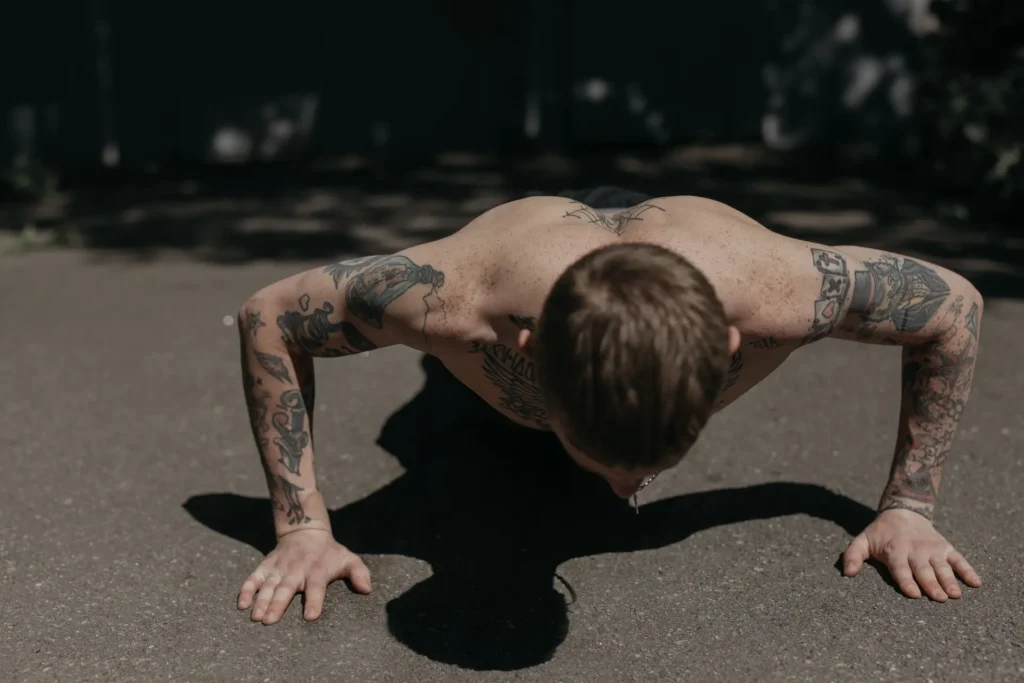
This home chest session uses five exercises to build overall pec thickness and improve fullness near the outer edge of your chest:
- Controlled Wide Push-Up
- Deficit Push-Up
- Archer Push-Up
- Band-Resisted Push-Up
- Dumbbell Floor Press
Complete two sets of each exercise for the full 20-minute routine. Beginners can start with three or four movements. More experienced trainees may add a third set when time allows.
A slightly wider push-up can work well for chest training. The problem begins when “wide” becomes the goal rather than a controlled adjustment.
In coaching sessions, I often see students move their hands so far apart that their chest barely lowers between them. Their shoulders drift into an unstable bottom position, the range gets shorter, and the exercise feels more targeted without producing better chest work.
This outer chest workout begins with a Controlled Wide Push-Up, then builds usable range, unilateral loading and external resistance. The goal is to develop the entire pectoralis major and improve fullness near its outer edge, not isolate a separate outer-chest muscle.
Use it as focused chest work within a broader system for choosing and progressing chest exercises at home.
Quick Summary
- The outer chest is not a separate muscle that can be isolated.
- An extremely wide push-up position may shorten your range and reduce control.
- A useful chest stretch should not pull your shoulders into an unstable position.
- Progress comes from usable range, unilateral loading and additional resistance.
- Bands and dumbbells offer measurable ways to progress beyond basic push-ups.
- Muscle insertions, body fat and overall pec development all affect chest shape.
How Do You Work the Outside of Your Chest?
The “outer chest” usually describes the part of the pectoralis major near the upper arm and armpit. It is a visual region, not an independent muscle.
Anatomically, the pectoralis major is typically described as having clavicular, sternocostal and abdominal portions. Standard anatomical descriptions do not identify a separate outer-chest head; “outer chest” is a practical term for the visible area near the upper arm.Cadaveric study describing the anatomical portions of the pectoralis major
An effective outer chest exercise should train the whole pec while providing enough range and resistance to support growth. The goal is not to create an extreme pulling sensation near the armpit. It is to lower under control, maintain a stable pressing position and gradually make the movement harder.
Hand position matters, but width alone does not determine whether a push-up is productive. A slightly wider stance works only when your chest can still descend between your hands, your elbows follow a controlled path and your shoulders remain supported.
If moving your hands farther apart shortens the movement or changes your bottom position, bring them closer together. A useful outer pec workout is less about finding one special exercise and more about choosing movements you can progressively load.
5 Outer Chest Exercises at Home
These outer chest exercises at home are organized by purpose rather than popularity. Each movement changes a different training variable instead of repeating the same wide-grip pattern.
The first three movements use calisthenics-based progressions to develop pressing control, usable range and unilateral loading. Bands and dumbbells then provide clearer ways to add resistance.
These outer pec exercises train the entire pectoralis major.
“Outer-chest emphasis” describes the article’s visual goal: improving overall pec thickness and fullness near its outer edge. It does not mean selectively activating a separate outer-chest muscle.
1. Controlled Wide Push-Up
Video: More Than Lifting
Main Muscles Worked:Pectoralis major (outer-chest emphasis),Triceps
How to Do It
- Place your hands slightly wider than shoulder-width.
- Brace your core and glutes, keeping your body in a straight line.
- Bend your elbows diagonally backward and lower your chest between your hands.
- Stop at the lowest position you can control without losing your supported shoulder position.
- Press through your hands to return to the starting position.
Practical Tips
- Slightly wider is enough. Do not chase the widest possible hand position.
- Lower your chest between your hands instead of reaching forward with your head.
- Prioritize controlled range of motion over hand width.
Troubleshooting
- Front shoulder discomfort: Narrow your hand position and keep your elbows closer to your torso.
- Very short range: Your hands may be too wide.
- Hips sagging: Brace your abs and glutes or perform fewer repetitions.
Role in the Routine
People searching for outer chest push ups often assume their hands should be placed as wide as possible. The Controlled Wide Push-Up establishes a stable pressing path without treating extreme hand width as the key to chest development.
2. Deficit Push-Up
Video: Gaintrust Bodybuilding
Main Muscles Worked:Pectoralis major (outer-chest emphasis),Triceps
How to Do It
- Place each hand on an equally high, stable support.
- Extend your legs and keep your body in a straight line.
- Bend your elbows and slowly lower your chest below hand level.
- Stop at the deepest position you can control without losing shoulder stability.
- Maintain chest tension and press back to the top.
Practical Tips
- The supports create more space for your chest; they should not force your shoulders into an extreme position.
- Begin with low supports and increase the depth only after you can control it.
- Do not bounce out of the bottom position.
Troubleshooting
- Shoulders become unstable at the bottom: Reduce the depth.
- Chest cannot pass below your hands: Use higher supports or improve your standard push-up first.
- Uneven descent: Check that both supports are equal in height and distance.
Role in the Routine
The Deficit Push-Up adds range after a stable pressing path has been established. It helps distinguish a controlled chest stretch from a bottom position that exceeds your current shoulder control.
Increase the depth only while you can lower and press through the same stable path.
3. Archer Push-Up
Video: Andrew Alinda
Main Muscles Worked:Pectoralis major (outer-chest emphasis),Triceps
How to Do It
- Begin with your hands wider than in a standard push-up.
- Shift your body toward one side, placing more weight over the working arm.
- Bend the working elbow while gradually straightening the opposite arm.
- Lower your chest toward the working hand without rotating your torso.
- Press through the working side to return to the center, then repeat on the other side.
Practical Tips
- Move your whole body sideways rather than bending only one elbow.
- The assisting arm can remain slightly bent while you learn the movement.
- Begin with a small weight shift before attempting a deeper single-side repetition.
Troubleshooting
- Torso rotates: Reduce the lateral shift and brace your core and glutes.
- Cannot press back up: Perform the movement with your hands elevated.
- Assisting shoulder feels overstretched: Use a narrower hand position.
Role in the Routine
The Archer Push-Up increases unilateral chest loading without additional weight. It bridges the gap between bilateral push-ups and exercises that use external resistance.
In more advanced outer chest workouts, progress by shifting more body weight toward the working side. Do not rush to straighten the assisting arm if doing so causes your torso to rotate.
4. Band-Resisted Push-Up
Video: Rogue Fitness
Main Muscles Worked:Pectoralis major (outer-chest emphasis),Triceps
How to Do It
- Loop a resistance band across your upper back and secure each end beneath your hands.
- Enter a stable push-up position and make sure the band cannot slide toward your neck.
- Lower your body under control while keeping your torso rigid.
- Once your chest approaches the floor, press upward against the increasing resistance.
- Complete the press while keeping your body stable, then begin the next repetition.
Practical Tips
- Position the band across your upper back, not your neck or lower back.
- Choose a resistance that still allows a complete range of motion.
- Keep both ends securely pinned beneath your hands.
Troubleshooting
- Band slides toward your neck: Move it lower across the shoulder-blade area.
- Cannot complete the top of the repetition: Use a lighter band.
- Body shifts sideways: Check that the band length is even on both sides.
Role in the Routine
Resistance bands add pressing difficulty without changing your hand position or shortening the bottom range.
A controlled trial found that band-resisted push-ups and bench presses performed at comparable muscle-activity levels produced similar strength improvements. This supports band-resisted push-ups as a legitimate loading option when the resistance is challenging enough.Study comparing strength gains from bench presses and band-resisted push-ups
5. Dumbbell Floor Press
Video: Testosterone Nation
Main Muscles Worked:Pectoralis major (outer-chest emphasis),Triceps
How to Do It
- Lie on the floor with your knees bent and feet planted.
- Hold the dumbbells beside your chest with your wrists stacked over your elbows.
- Begin with your upper arms resting lightly on the floor.
- Press the dumbbells over your chest without knocking them together.
- Lower slowly until your upper arms gently contact the floor again.
Practical Tips
- Keep your wrists aligned with your forearms.
- Pause briefly when your upper arms reach the floor instead of bouncing.
- Use this exercise to add measurable pressing load, not to isolate an outer-chest muscle.
Troubleshooting
- Mostly feel your triceps: Let your elbows move slightly farther from your torso while keeping your wrists above your elbows. Do not flare them directly sideways.
- Shoulder discomfort: Use a neutral grip or reduce the weight.
- Uneven press: Choose lighter dumbbells and slow the lowering phase.
- Difficulty entering position: Rest the dumbbells on your thighs and carefully guide them into place as you lie back.
Role in the Routine
The Dumbbell Floor Press provides stable, measurable resistance after the bodyweight and band-resisted exercises. The floor limits how far your upper arms can travel behind your torso, allowing you to finish with external load without chasing additional depth.
For an outer chest workout with dumbbells, record the weight and repetitions used. Once both sets reach the top of the prescribed range with consistent form, increase the load slightly.
20-Minute Home Routine for Outer Chest
This 20-minute session follows a clear progression: stable hand position, usable range, unilateral loading and external resistance.
Three-Minute Preparation
- Shoulder Circles: 30 seconds in each direction
- Scapular Push-Ups: 8–10 reps
- Easy Push-Ups: 6–8 reps
| Exercise | Sets | Reps | Rest |
|---|---|---|---|
| Controlled Wide Push-Up | 2 | 10–15 reps | 45 sec |
| Deficit Push-Up | 2 | 8–12 reps | 60 sec |
| Archer Push-Up | 2 | 5–8 per side | 60–75 sec |
| Band-Resisted Push-Up | 2 | 6–12 reps | 60 sec |
| Dumbbell Floor Press | 2 | 8–12 reps | 60 sec |
Total time: approximately 20 minutes.
Allow a few extra minutes during your first session, especially when arranging the supports, resistance band and dumbbells. Once the setup becomes familiar, the routine should fit more comfortably within 20 minutes.
Training Rules
- Beginners can perform the Controlled Wide Push-Up, Deficit Push-Up and Dumbbell Floor Press before adding the Archer and band-resisted variations.
- Keep approximately 1–3 clean repetitions in reserve.
- Perform the workout once or twice per week.
- Leave at least 48 hours before another demanding chest session.
- Maintain the same hand position and range across repetitions.
- Stop increasing depth when you can no longer maintain shoulder control.
- Reach the top of the listed rep range with clean form before increasing resistance.
The order is deliberate. Controlled Wide Push-Ups establish your hand position. Deficit Push-Ups develop usable depth. Archer Push-Ups increase unilateral loading before the Band-Resisted Push-Up introduces external resistance. The Dumbbell Floor Press finishes the progression with a stable load that is easy to record.
Hand width and pressing angle solve different training problems. To emphasize the upper portion of the pecs, use the elevated pressing paths in this upper-chest workout designed for home training.
Safety Tips: Warm up your shoulders, wrists and chest before starting. Use stable, non-slip supports for Deficit Push-Ups, inspect your resistance band before every session, and begin the Dumbbell Floor Press with a weight you can control. Stop an exercise if it causes sharp pain.
Common Mistakes That Make Outer Chest Training Less Effective
1. Treating the Widest Hand Position as the Best Position
A wider hand position changes the exercise, but there is no benefit in widening your stance until your chest can barely descend.
The useful position is the widest one that still allows:
- a stable torso;
- controlled elbows;
- a meaningful range;
- supported shoulders;
- a full press without shifting your body.
A Controlled Wide Push-Up is still a wide push-up. The difference is that hand width remains a deliberate adjustment rather than the main measure of difficulty.
2. Confusing Shoulder Stress With a Chest Stretch
A stretch is useful only while the working muscles control it.
During a Deficit Push-Up, your chest may descend below your hands. That does not mean every extra inch is productive. Once your shoulders drift into an unstable bottom position and your upper arms lose their supported path, additional depth no longer serves the training goal.
Reduce the range and rebuild control before progressing again.
3. Increasing Range Without Controlling the Return
Some trainees can reach a deep bottom position but cannot reverse it without bouncing, twisting or collapsing. That is not usable range yet.
Lower slowly enough to recognize the bottom position, pause without relaxing, and press through the same path. If the return looks different from the descent, shorten the range until both parts of the repetition match.
4. Chasing Soreness Near the Armpit
Soreness can show that an area experienced unfamiliar stress, but it cannot prove that a separate outer-chest muscle was isolated.
The area around the armpit includes more than the pectoralis major. Treat soreness as one piece of feedback, not your main measure of success.
More useful markers include:
- consistent range across every repetition;
- better control at the bottom;
- a larger Archer Push-Up weight shift;
- a stronger resistance band;
- more dumbbell weight;
- more clean repetitions at the same load.
5. Expecting Exercise to Change Chest Insertions
Training can increase overall chest thickness and make the outer edge appear fuller. It cannot move your natural muscle attachment points or determine the exact shape of your chest.
Body fat also affects how clearly the chest meets the upper arm. Additional exercises cannot selectively remove fat near the armpit.
If the lower border of your pecs is the area you want to prioritize, use this home-friendly lower-chest workout rather than adding unrelated downward pressing movements to this routine.
Progression Tips for a Fuller Outer Chest
Follow the same progression used in the routine instead of immediately widening your hands or choosing a more extreme variation.
1. Reach the Top of the Rep Range
Complete every repetition with the same hand position, depth and torso alignment. Once both sets reach the top of the range, progress one variable.
2. Increase Only Usable Range
Use slightly higher supports for Deficit Push-Ups only while your shoulders remain stable. Do not continue raising the supports if your control changes from one set to the next.
3. Increase the Archer Weight Shift
Move more body weight toward the working arm before trying to straighten the assisting arm completely.
4. Add Band Resistance
Move to a stronger band only when you can complete every repetition without shortening the bottom range or losing torso position.
5. Increase Dumbbell Weight
Add the smallest practical amount of weight once you can complete both sets at the top of the range without bouncing your upper arms off the floor.
6. Recheck the Movement
After every progression, ask:
- Did the range become shorter?
- Did I lose shoulder control?
- Did my torso start rotating?
- Did the final repetitions follow a different path?
If the answer is yes, the progression is ahead of your current control. Step back, rebuild the movement and try again later.
Frequently Asked Questions
Can You Target the Outer Chest?
You cannot isolate a separate outer-chest muscle because the term describes a visual region of the pectoralis major rather than an independent muscle.
You can still improve fullness near its outer edge by developing the entire chest through controlled pressing, sufficient resistance and consistent progression. Exercise selection can change the loading conditions, but it cannot change your natural muscle insertions.
Can You Build an Outer Chest at Home?
You can build your chest at home and improve fullness near its outer edge. What you cannot do is isolate a separate outer-chest muscle or change its natural attachment points.
Push-up variations can support chest development when their difficulty matches your current strength. In one small eight-week study involving untrained men, load-matched push-up and low-load bench-press training produced similar increases in pectoralis major thickness.
This does not mean every push-up variation is equivalent to bench pressing. It shows that progressive push-up training can be a valid home option when the exercise remains challenging.Study comparing hypertrophy from low-load bench presses and push-ups
Beginners can progress through hand position, usable range and Archer Push-Ups. Stronger trainees can add resistance bands, a weighted vest or dumbbells. The equipment matters less than having a movement that remains challenging and measurable.
How Do You Build Muscle on the Side of Your Chest?
Train the pectoralis major consistently, use a range you can control and gradually increase the demand. Adequate recovery and nutrition also support overall muscle development.
The final visual result depends on more than training. Muscle insertions, chest structure and body-fat level all affect how the outside of your chest appears.
Which Exercise Is Best for the Side of the Chest?
There is no single best exercise for every trainee.
Start with the Controlled Wide Push-Up if you are still establishing your hand position. Use the Deficit Push-Up for more controlled range, the Archer Push-Up for unilateral loading, or the Band-Resisted Push-Up and Dumbbell Floor Press when you need external resistance.
The best choice is the movement you can progress without losing chest range or shoulder stability.
Conclusion
There is no separate outer-chest muscle to isolate, but that does not make your goal meaningless. Building the pectoralis major as a whole can add thickness and improve how the chest meets the upper arm.
When I coach this type of training, I focus on steady progress rather than chasing a wider hand position or a stronger stretch. Keep the range controlled, let the shoulders stay stable, and gradually increase the unilateral or external load.
Visible changes take time, especially when chest shape and muscle insertions differ from person to person. Choose the three movements that match your current level, record today’s reps and resistance, and return next week ready to earn one small progression.