
Biceps Femoris Exercises at Home: 3 Outer Hamstring Moves
By Zephyr · Published Jul 15, 2026
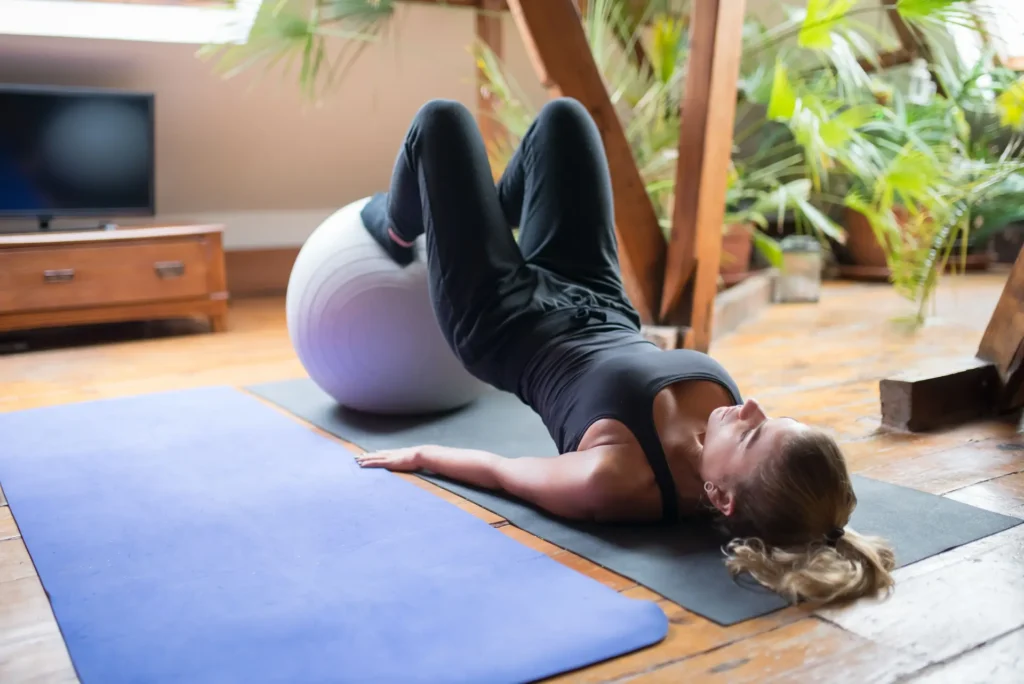
These biceps femoris exercises at home train the outside of your hamstrings with dumbbells, a resistance band and a stability ball. The routine combines one loaded hip hinge with two knee-flexion movements instead of treating every hamstring exercise as interchangeable.
The biceps femoris has two heads with different training roles. Its long head helps extend the hip and bend the knee, while its short head only crosses the knee. Repeating deadlift variations may therefore leave part of the muscle’s function undertrained.
This is a strength and muscle-building routine, not rehabilitation for a strain, tendon problem or unexplained pain. Use it as focused hamstring work inside a beginner thigh routine that trains both sides of the upper leg.
Quick Summary
- The biceps femoris forms the lateral, or outside, portion of the hamstrings.
- Its long head works at the hip and knee; its short head only works at the knee.
- Combine a hip hinge with direct knee-flexion work instead of relying on one movement.
- Exercise selection can change muscular emphasis, but it cannot switch the other hamstrings off.
- This routine uses a dumbbell stiff-legged deadlift, prone band curl and Swiss-ball hamstring curl.
What Exercises Target the Biceps Femoris?
The biceps femoris responds to two main training tasks: hip extension and knee flexion. A hip hinge trains the long head as it helps extend the hip, while a curl trains both heads by making the hamstrings bend the knee against resistance.
This distinction matters because the biceps femoris short head does not cross the hip. Deadlift variations can train the long head, but they cannot reproduce the short head’s knee-flexion role. A practical routine should therefore combine one controlled hinge with at least one direct curl instead of expecting either pattern to do everything.
An exercise-selection study comparing lateral and medial hamstring activation across several strength movements found that the relative contribution of the hamstring muscles changed with the exercise. Hip-extension work produced a greater biceps-femoris-to-medial-hamstring activation ratio than some knee-flexion movements. This supports using exercise selection to create emphasis, but it does not mean the biceps femoris can be completely isolated.
3 Biceps Femoris Exercises for Outer Hamstring Training
These three movements perform different jobs: loaded hip extension, direct knee flexion and knee flexion with additional hip-position control. You do not need an exaggerated stance or forced foot rotation to make them effective.
1. Dumbbell Stiff-Legged Deadlift
Video: Renaissance Periodization
Main Muscles Worked:
Hamstrings, with an emphasis on the biceps femoris long head through the hip-hinge pattern.
Role in the Workout:
I would place this exercise first because it is the main loaded movement. It trains hip extension while you are fresh and makes resistance relatively easy to record and progress.
In this article, “stiff-legged” means keeping the knees closer to straight and limiting the descent to a range you can control. Exercise names vary among coaches, and this setup does not remove the glutes or isolate the biceps femoris.
How to Do It:
- Stand with your feet about hip-width apart and hold the dumbbells in front of your thighs.
- Keep your knees soft, then push your hips backward as the dumbbells travel close to your legs.
- Lower until you feel strong hamstring tension without rounding your back.
- Drive your feet into the floor and bring your hips forward to stand.
How It Should Feel:
You should feel tension building along the back of your thighs as your hips move backward. The load should not concentrate in your lower back.
Practical Tip:
Let hamstring tension and pelvic control determine the depth. The dumbbells do not need to reach the floor.
Troubleshooting:
- If your lower back rounds, shorten the range and use lighter dumbbells.
- If the movement feels like a squat, keep your shins more vertical and send your hips farther back.
- If balance limits you, practise the hinge without weight while standing a short distance in front of a wall.
If your hinges repeatedly become glute- or lower-back-dominant, this separate guide to developing clearer hip-extension control with simple home exercises can help you understand how the hips should contribute without forcing additional depth.
2. Band Prone Hamstring Curl
Video: Testosterone Nation
Main Muscles Worked:
Hamstrings, with direct knee-flexion work for the long and short heads of the biceps femoris.
Role in the Workout:
I would place this exercise second because it supplies the knee-flexion work that the stiff-legged deadlift cannot reproduce. The prone position also removes most of the balance demand, helping you concentrate on bending and extending your knees under control.
A prone band curl is not mechanically identical to a seated machine curl because the position of the hip changes hamstring length. Its role here is to provide controllable knee-flexion resistance with equipment you can use at home.
How to Do It:
- Secure the band to a low, stable point behind your feet and loop the other end around your ankles.
- Lie face down with your legs extended and keep the front of your hips against the floor.
- Curl your heels toward your glutes without lifting your hips.
- Pause briefly, then extend your knees slowly instead of letting the band pull your legs down.
How It Should Feel:
You should feel the back of your thighs shortening as your knees bend. Your hips should remain down and your lower back should stay quiet.
Practical Tip:
Move far enough from the anchor to remove slack, but do not begin with so much tension that you lose control of the return.
An MRI study comparing hamstring recruitment at different hip and knee positions found that joint position affected exercise performance and muscular recruitment. It supports treating hip-extension, prone-curl and seated-curl patterns as related but different tasks—not assuming that a home band curl perfectly duplicates a seated machine curl.
Troubleshooting:
- If your hips lift, reduce the band tension or shorten the range.
- If the band rubs or pulls unevenly, adjust the ankle loops before continuing.
- If one leg finishes earlier, slow the movement and compare both sides before adding resistance.
3. Swiss-Ball Hamstring Curl
Video: Nuffield Health
Main Muscles Worked:
Hamstrings, including the biceps femoris, with additional hip-position control.
Role in the Workout:
I would use this exercise last because it combines knee flexion with more pelvic and trunk control. It works well as a finishing movement after the heavier hinge and more stable band curl.
How to Do It:
- Lie on your back with your heels on the ball and your arms resting on the floor.
- Raise your hips until your shoulders, hips and knees form a controlled line.
- Bend your knees and pull the ball toward you while keeping your hips elevated.
- Roll the ball away slowly without letting your pelvis drop suddenly.
How It Should Feel:
You should feel your hamstrings working as the ball moves toward you. Some stabilization effort is normal, but your lower back should not take over.
Practical Tip:
Keep the ball beneath your heels rather than your calves. If the full movement is too difficult, begin with a shorter curl while maintaining your hip position.
A controlled comparison of Nordic and ball leg curls recorded activity in both the biceps femoris and semitendinosus during the ball curl. The Nordic produced higher activation at the knee angles examined, so the study supports the ball curl as a legitimate hamstring exercise—not as a superior movement or a method of isolating one muscle.
Troubleshooting:
- If your hips keep dropping, begin with bridge holds or use a shorter curl range.
- If the ball moves sideways, slow down and apply even pressure through both heels.
- If your calves cramp, relax your ankles and focus on pulling with the back of your thighs.
15–20-Minute Biceps Femoris Workout at Home
This focused routine uses only three exercises because each one performs a distinct task. Adding more movements is unnecessary if they simply repeat the same hinge or curl pattern.
Main Workout
| Exercise | Sets | Reps | Rest |
|---|---|---|---|
| Dumbbell Stiff-Legged Deadlift | 3 | 8–12 | 75–90 sec |
| Band Prone Hamstring Curl | 2–3 | 10–15 | 45–60 sec |
| Swiss-Ball Hamstring Curl | 2–3 | 6–12 | 60 sec |
How to Use This Routine
Perform the exercises in the listed order. Complete the loaded hinge first, use the band curl for direct knee-flexion work, and finish with the ball curl when stability becomes part of the challenge.
Do not compare the dumbbell weight used in the deadlift with the tension used in the band curl. Hip extension and knee flexion have different leverage and loading demands, so a much lighter curl can still be challenging.
Choose a resistance that allows you to finish each set with approximately one to three clean repetitions still possible. The final repetitions should feel difficult, but your range should not become shorter and your lower back should not take over.
Add this block after your primary squat or compound leg work, or use it as a short secondary lower-body session. One or two sessions per week is a practical starting point when the rest of your program already includes meaningful hamstring work.
Safety Tips: Check the band, anchor point, dumbbells and ball before starting. Use a clear, non-slip floor and remain within a range you can actively reverse. Stop if you experience sharp pain, sudden weakness, bruising or pain near the outside of your knee. This routine is not treatment for a biceps femoris strain or tendinopathy.
Common Mistakes
1. Doing Only Hip Hinges
Stiff-legged deadlifts and RDLs train the biceps femoris long head through hip extension, but they do not reproduce loaded knee flexion. Include a curl pattern if you want to cover both functions.
If you want to compare this lateral-hamstring emphasis with a different home-training approach for the more superficial medial side of the hamstrings, the semitendinosus routine uses a different balance of knee-flexion work
2. Turning the Deadlift Into a Squat
Excessive knee bending moves your hips downward instead of backward. Keep your knees soft, your shins relatively vertical and the dumbbells close to your legs.
3. Lowering Beyond Your Controllable Range
Reaching the floor is not the objective. End the descent when hamstring tension is strong and before your lower back rounds or your pelvis loses position.
4. Dropping the Hips During Curls
If your hips collapse during the Swiss-ball curl, the movement loses its intended combination of knee flexion and hip-position control. Reduce the range or return to bridge holds.
5. Using Foot Rotation as an Isolation Technique
The biceps femoris contributes to external rotation of the flexed knee, but forcefully turning your feet outward does not make the other hamstrings stop working. Use a comfortable position that lets you bend and extend your knees cleanly.
6. Progressing Before You Control the Return
Allowing a band or ball to pull your legs rapidly into extension removes control from an important part of the repetition. Slow the return before adding resistance.
Exercise Regressions and Progression Tips
Dumbbell Stiff-Legged Deadlift
Begin with a bodyweight wall hinge or one light dumbbell. Build a controllable range first, then add repetitions and finally increase the load. Do not lower the weight farther once your spine or pelvis begins to change position.Band Prone Hamstring Curl
Begin with a lighter band or partial repetitions that you can return slowly. Reach a full, controlled range before increasing band tension. You can then add a brief pause at the top or slow the lowering phase.Swiss-Ball Hamstring Curl
Begin with a two-leg bridge hold, followed by short-range curls and then full repetitions. Once full curls are stable, slow the return before considering a single-leg variation.
This routine can support muscle growth when you gradually increase usable range, repetitions or resistance and recover between sessions. Local burning and next-day soreness are not reliable measures of growth by themselves.
A training study comparing knee flexion at longer and shorter hamstring muscle lengths reported greater hamstring hypertrophy in the longer-length condition. The study used seated and prone leg-curl training rather than the home movements in this routine, so it does not prove that one of these exercises is superior. The practical lesson is to develop strength through a controlled range instead of adding load to shortened repetitions.
Frequently Asked Questions
Can you isolate the biceps femoris?
No. Exercise selection can place relatively more emphasis on the lateral hamstrings, but the semitendinosus, semimembranosus, glutes and other muscles will continue to contribute.
Do Romanian deadlifts work the biceps femoris?
Yes. Romanian deadlifts train the hamstrings through hip extension and can involve the biceps femoris long head. However, they do not directly reproduce loaded knee flexion and cannot replace every curl pattern.
What is the difference between a stiff-legged deadlift and a Romanian deadlift?
Both are hip hinges, and their names are sometimes used inconsistently. In this routine, “stiff-legged” means keeping the knees closer to straight, while a Romanian deadlift commonly allows slightly more knee flexion. Neither movement requires you to lock your knees.
What exercises work the short head of the biceps femoris?
The short head does not cross the hip, so knee-flexion exercises such as prone band curls and Swiss-ball curls are more directly relevant than hip-extension-only movements.
Do I need Nordic curls to train the biceps femoris?
No. Nordic curls provide demanding knee-flexion work, especially during the lowering phase, but they are not mandatory. A hip-extension exercise and controllable curl variations can still create a practical routine when you do not have a safe Nordic setup or cannot yet control the movement.
Can this home routine build muscle?
It can contribute to muscle growth when the sets become sufficiently challenging and you progress them over time. Results also depend on total training volume, recovery, nutrition and consistency. No exercise can guarantee isolated growth of one hamstring head.
How often should I train the biceps femoris?
One or two focused sessions per week is a reasonable starting point when your leg program already includes other hamstring work. Allow your performance to recover before repeating hard sets.
Should I turn my feet outward during hamstring curls?
It is unnecessary. Small changes in leg position may affect how an exercise feels, but they do not completely isolate the biceps femoris. Keep your ankles and knees in a stable position that allows controlled movement.
Are squats enough for the biceps femoris?
Squats involve the posterior chain but do not replace targeted hip-extension and knee-flexion work. If developing the lateral hamstrings is your goal, include exercises that directly load those functions.
What should I do if I feel pain near the outside of my knee?
Stop the exercise rather than trying to correct persistent pain with training cues. Swelling, bruising, instability, sudden weakness or continuing pain should be assessed by a qualified healthcare professional.
Conclusion
Effective biceps femoris exercises do not depend on a special foot angle or an unnecessarily long movement list. They need to cover the actual training tasks performed by the muscle.
The dumbbell stiff-legged deadlift loads hip extension, the prone band curl supplies direct knee flexion, and the Swiss-ball curl adds hip-position control to the curl pattern.
This is focused lateral-hamstring work rather than a complete hamstring workout. For another comparison, the related home routine that combines controlled hip extension with medial-hamstring knee-flexion work shows how the training emphasis can change without pretending that either muscle works alone.
Use this routine as one focused part of your leg program, and let repeatable range, controlled repetitions and gradual loading drive your progress.
Medical disclaimer: This article is intended for educational and informational purposes only. It is not intended as a substitute for medical advice. For health advice, contact a licensed healthcare provider.