
Lat Workouts at Home: 5 Moves to Build a Wider Back
By Zephyr · Published Jun 14, 2026
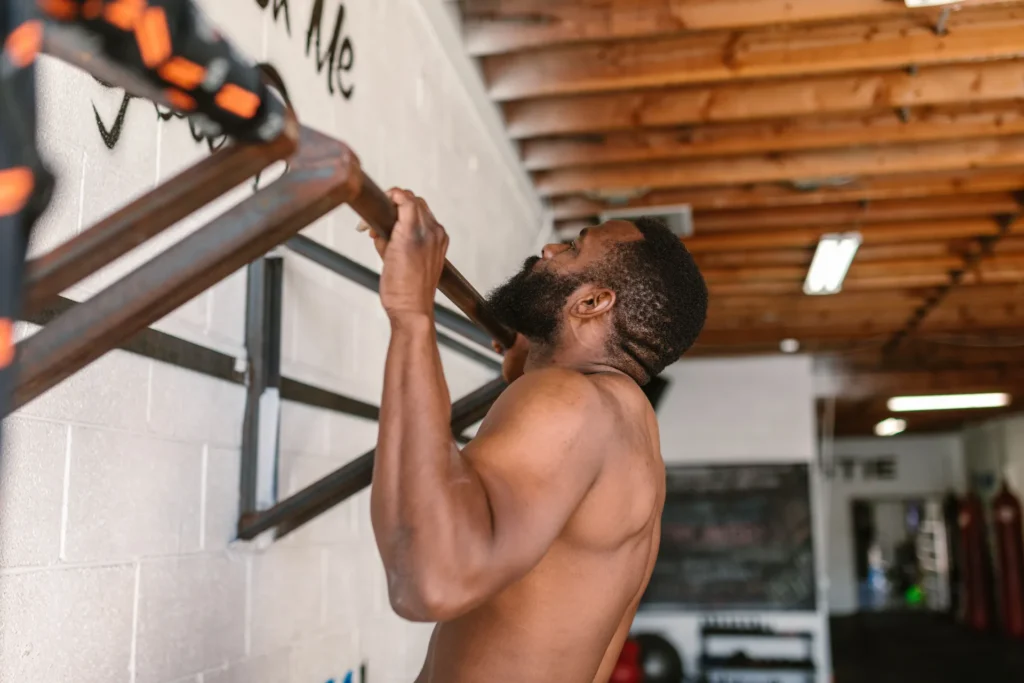
These lat workouts use five home-friendly pulling exercises to train your back through vertical pulls, horizontal rows, unilateral loading, and straight-arm shoulder extension:
- Band-Assisted Pull-Up
- Feet-Elevated Ring Row
- Single-Arm Dumbbell Row
- Half-Kneeling Single-Arm Band Lat Pulldown
- Straight-Arm Band Pulldown
Perform 2–3 sets per exercise for 5–15 controlled reps, resting 45–75 seconds between sets. Beginners should use easier variations instead of forcing every movement at full difficulty.
I like pull-ups, and I use them often when teaching home back training. But I would not build an entire back session around pull-ups alone.
Some students cannot complete enough clean reps yet. Others reach the bar by tightening their arms, shrugging their shoulders, or swinging through the hardest part. In either case, simply adding more pull-ups does not solve the problem.
That is why these lat workouts use several pulling paths. Assisted pull-ups build vertical pulling strength, ring rows provide adjustable bodyweight resistance, a dumbbell row adds measurable load, and the band exercises let you practice the pulldown path without asking tired biceps to control every set.
Together, they create a practical home workout for building stronger lats and adding width to your back.
This session fits naturally inside a broader home back-training system that combines vertical pulls, rows, hinges, and shoulder-blade control.
Quick Summary
- Effective lat exercises at home need enough pulling resistance to challenge the back.
- Vertical pulls, horizontal rows, and straight-arm pulldowns each have a different job.
- Feeling your lats contract is useful, but it is not the only sign of a productive set.
- Train this routine once or twice per week, with recovery between sessions.
- A lats workout at home can use a pull-up bar, rings, resistance bands, and one dumbbell.
No equipment yet? Begin with this introductory back workout for beginners that requires no equipment
How Do I Build My Lats at Home?
To train your lats at home, your upper arms need to move down or back against meaningful resistance. Copying the shape of a pulling exercise without enough load will not create the same training demand.
A complete plan uses several pulling paths:
- A vertical pull drives the elbows down beside the body.
- A horizontal row moves the elbows behind the torso.
- A unilateral row provides a load you can record and increase.
- A straight-arm pulldown trains shoulder extension with less elbow movement.
These exercises for lats should not all feel identical. Pull-ups require more total-body control, rows make it easier to adjust the load, and straight-arm work remains useful when the biceps begin limiting regular pulling exercises.
The practical answer to how to train lats at home is not to search for one perfect movement. Combine several pulling roles, control the range, and progress something you can measure.
5 Best Lat Exercises for Home Training
Effective home exercises should provide enough resistance, allow a controlled return, and offer a clear way to progress. Each movement below has its own job instead of repeating the same pulling pattern five times.
1. Band-Assisted Pull-Up
Video: REP
Main Muscles Worked:Latissimus dorsi
Equipment: Pull-up bar and resistance band
How to Do It
- Secure a resistance band around the bar and place one foot or knee inside it.
- Grip the bar slightly wider than shoulder-width, then brace your core and glutes.
- Move your shoulders away from your ears and drive your elbows down beside your body.
- Pull your upper chest toward the bar instead of reaching forward with your chin.
- Lower yourself under control until your arms are extended.
Practical Tips
- Think about driving your elbows down instead of pulling harder with your hands.
- You may feel tension behind your armpits and along the sides of your back as you rise.
- Use only enough assistance to complete the full range cleanly.
- If you cannot complete one full repetition, switch to a stronger band.
- Do not force an extremely wide grip. Use a width that allows a controlled pull without shortening your range.
A lat-pulldown study reported similar latissimus dorsi activity across narrow, medium, and wide pronated grips. Participants lifted slightly more with narrow and medium grips than with the widest position. Because the study tested pulldowns rather than pull-ups, it does not establish an ideal pull-up grip. It does, however, challenge the assumption that an unnecessarily wide grip is required to involve the lats.Study comparing grip widths during lat pulldowns
Troubleshooting
- Your arms fatigue first:Reduce the reps and begin by moving your shoulders down before bending your elbows.
- Your body swings:Brace your core or use more assistance.
- You only complete short partial reps:Use a stronger band instead of forcing an uncontrolled range.
You cannot reach the top:Do not push your neck forward to make the repetition look complete.
Role in the Routine
The assisted pull-up is the main vertical pull, so it comes first while your grip, coordination, and pulling strength are fresh.
A study of 33 participants found that vertical elastic-band assistance increased the average number of pull-ups completed in one set from 11.35 to 17.61. This directly supports using a band to increase the available repetitions when unassisted pull-ups are too demanding. The study measured a single set to voluntary fatigue; it did not assess technique quality, long-term strength gains, or muscle growth.Study on elastic-band assistance during pull-ups
2. Feet-Elevated Ring Row
Video: Jerry Teixeira
Main Muscles Worked:Latissimus dorsi
Equipment: Rings and a stable foot support
How to Do It
- Secure both rings and adjust them to the same height.
- Place your feet on a stable, non-slip support and grip the rings.
- Brace your core and glutes so your body remains straight.
- Pull the rings toward your lower ribs while driving your elbows back beside your body.
- Pause briefly, then lower yourself until your arms are extended.
Practical Tips
- Think about moving your elbows behind you rather than pulling only with your hands.
- Pull toward your lower ribs instead of your shoulders.
- Let your arms extend on the return without allowing your hips to drop.
- For an easier version, keep both feet on the floor.
Troubleshooting
- You mainly feel your upper back: Your elbows may be flaring, or you may be pulling the rings too high.
- You cannot feel the sides of your back: Slow the return and begin each rep with your arms more fully extended.
- Your hips drop: Tighten your glutes or remove the foot elevation.
- The rings swing: Choose an easier body angle and confirm that both rings are level.
- The foot support moves: Stop and switch to a more stable setup.
Role in the Routine
Ring rows add horizontal pulling and allow you to adjust bodyweight resistance through foot position and body angle.
A 2023 study found that an isotonic TRX inverted row performed with the feet supported in a second suspension device produced strap force equivalent to 72.64% of the participants’ estimated lying barbell row 1-RM. This differs from the stable foot support used here, so it does not quantify the load of this exact ring-row variation. It does show that a feet-supported suspension row can provide substantial, measurable resistance.Study measuring load during feet-supported suspension inverted rows
3. Single-Arm Dumbbell Row
Video: Vivian Ngo / Team Evolve
Main Muscles Worked:Latissimus dorsi
Equipment: Dumbbell and stable support
How to Do It
- Support one hand on a stable bench or sofa and plant both feet firmly.
- Keep your torso steady and allow the working arm to hang naturally.
- Drive your elbow back and slightly toward your hip.
- Pull the dumbbell beside your torso without rotating your body.
- Lower it slowly until your arm is extended again.
Practical Tips
- Imagine moving your elbow toward your back pocket instead of simply lifting the dumbbell.
- The working side should tighten from behind the armpit toward the waist.
- Let the shoulder blade move naturally at the bottom without relaxing your torso.
- Choose a weight you can control throughout the lowering phase.
Troubleshooting
- Your torso rotates: Reduce the weight and keep your chest facing the floor.
- Your biceps fatigue first: Relax excessive grip tension and slow the elbow path.
- You mainly feel your upper back: Your elbow may be traveling too high or too far outward.
- The dumbbell drops quickly: The load is too heavy to control.
Role in the Routine
For anyone looking for a lat workout with dumbbells, the single-arm row provides a load that can be measured and increased over time. It adds external resistance without turning the session into a dumbbell-only workout.
4. Half-Kneeling Single-Arm Band Lat Pulldown
Video: Functional AF
Main Muscles Worked:Latissimus dorsi
Equipment:Resistance band and secure overhead anchor
How to Do It
- Anchor the band above and slightly in front of you.
- Set up in a stable half-kneeling position and reach toward the anchor.
- Keep your rib cage stable and drive your elbow toward your side and lower ribs.
- Pause at the bottom without leaning backward.
- Control the return overhead before beginning the next repetition.
Practical Tips
- Imagine moving your elbow toward your back pocket.
- Keep your hips and chest facing forward.
- Control the return instead of letting the band pull your arm upward.
- Choose a resistance that allows your torso to remain still.
Troubleshooting
- You only feel your arm: Reduce the resistance and slow the elbow movement.
- You lean backward: Use a lighter band or move closer to the anchor.
- Your torso rotates: Brace your core and reduce the resistance.
- Your shoulder remains shrugged: Move it gently away from your ear before pulling.
Role in the Routine
This unilateral pulldown helps you practice a controlled elbow path without allowing the stronger side to hide a weaker or less coordinated side.
5. Straight-Arm Band Pulldown
Video: STRONG ATHLETE
Main Muscles Worked:Latissimus dorsi
Equipment:Resistance band and secure overhead anchor
How to Do It
- Hold a band anchored above and in front of your body.
- Reach toward the anchor with a slight, fixed bend in your elbows.
- Keep your rib cage stable and pull your hands toward your thighs in an arc.
- Pause briefly while maintaining tension along the sides of your back.
- Return overhead slowly.
Practical Tips
- Drive your upper arms toward your thighs instead of pulling down with your hands.
- Keep the elbow angle nearly fixed.
- Do not force your hands behind your body.
- If the movement feels too easy, bend your knees and hinge slightly at the hips to increase the range and band tension.
Troubleshooting
- It becomes a regular pulldown: Reduce the resistance and stop repeatedly bending your elbows.
- You mainly feel your triceps: Do not actively straighten your arms.
- Your lower back arches: Brace your core and reduce the resistance or forward hinge.
- You cannot control the return: Move closer to the anchor or use a lighter band.
Role in the Routine
Straight-arm pulldowns finish the session with less elbow movement, allowing your lats to keep working after your biceps have already handled the compound pulls.
20-Minute Home Lat Routine
This routine takes about 20 minutes once your equipment is ready.
Three-Minute Preparation
- Controlled Dead Hang: 20–30 seconds
- Scapular Pull-Up: 6–8 reps
- Easy Ring Row: 6 reps
- Light Straight-Arm Band Pulldown: 8 reps
Main Workout
| Exercise | Sets | Reps | Rest | Time |
|---|---|---|---|---|
| Band-Assisted Pull-Up | 3 | 5–8 | 75 sec | 4 min |
| Feet-Elevated Ring Row | 2 | 8–12 | 60 sec | 3 min |
| Single-Arm Dumbbell Row | 2 | 8–12 per side | 60 sec | 4 min |
| Half-Kneeling Band Lat Pulldown | 2 | 10–12 per side | 45 sec | 3 min |
| Straight-Arm Band Pulldown | 2 | 12–15 | 45 sec | 2–3 min |
This session combines calisthenics pulling movements with simple resistance tools. Choose the variation that preserves the intended pulling path instead of automatically choosing the hardest option.
Beginner and Equipment Alternatives
| Main Exercise | Easier Version or Alternative |
|---|---|
| Band-Assisted Pull-Up | Use a stronger band or perform a high-anchored band pulldown |
| Feet-Elevated Ring Row | Keep both feet down and raise the rings |
| Single-Arm Dumbbell Row | Use a lighter dumbbell or securely loaded backpack |
| Single-Arm Band Pulldown | Use a lighter band and move closer to the anchor |
| Straight-Armed Band Pulldown | Move closer to the anchor and reduce the forward hinge |
Safety Tips: Inspect the pull-up bar, rings, bands, and anchor points before training. Foot supports must be stable and non-slip, and resistance bands should have no visible cracks or tears. Never hang from door panels, loose furniture, or unverified horizontal supports. Stop the set if you experience sharp shoulder, elbow, or back pain.
Common Mistakes That Keep Your Arms in Control
Bending the Elbows Before the Pull Has Started
If every repetition begins with an aggressive elbow bend, the biceps may take over too early. Begin by controlling the shoulder blade and directing the upper arm along the intended path. Let the elbow bend as part of the pull rather than making it the entire movement.
Chasing a Better Burn With Too Little Resistance
A clear contraction can help you learn the movement, but it cannot replace sufficient resistance. If you can keep adding repetitions without approaching fatigue, increase the tension or choose a harder variation.
Using Momentum Once the Arms Get Tired
Swinging through pull-ups, rotating during rows, and leaning backward during pulldowns may help you finish another repetition, but they also change the exercise. End the set when you can no longer control the intended range.
Relying Only on Vertical Pulls
Pull-ups are valuable, but they cannot replace every horizontal row or straight-arm exercise. Using more than one pulling direction helps distribute fatigue and gives you more ways to progress.
Treating Soreness as Proof That the Workout Worked
Soreness can tell you that an area was stressed, but its absence does not mean the workout failed. Rep quality, resistance, usable range, and long-term performance are more reliable measures.
Progression for Stronger Lat Training
Pull-Up Progression
Strong assistance band
- lighter assistance band
- 1–3 unassisted reps followed by assisted volume
- complete unassisted sets
- additional repetitions or external load
Ring Row Progression
High rings with feet on the floor
- lower body angle
- feet elevated
- slower lowering or top pause
- external load
In lat bodyweight workouts, leverage provides resistance. Changing your body angle can be a meaningful progression even when no external weight is added.
Dumbbell Row Progression
First, reach the top of the listed rep range while maintaining the same torso position and controlled range. Increase the weight slightly, then rebuild your repetitions.
Band Pulldown Progression
Move farther from the anchor, use a stronger band, add a controlled pause, or slow the return. Change only one variable at a time.
Bodyweight lat exercises and band movements remain useful only when the harder version preserves the same pulling path.
Frequently Asked Questions
Why Do I Never Feel My Lats Working?
The biceps, forearms, rear shoulders, and upper back all contribute to pulling, so it is normal to feel more than one muscle working.
If your arms consistently end every set before your back is challenged, reduce the difficulty and check your elbow path. The half-kneeling pulldown is a useful place to practice the movement with less total load.
Are Lats Difficult to Grow?
The lats are not automatically harder to develop than every other muscle. More common problems include insufficient resistance, shortened repetitions, repeating the same pulling pattern, and allowing grip or arm fatigue to end every set.
Learning to feel the lats may improve your control, but the exercise still needs to become progressively more challenging.
What Is the Best Lat Workout?
The best lat workouts use more than one pulling direction. A practical session should include a vertical pull, horizontal row, measurable unilateral exercise, and straight-arm shoulder extension.
It must also match your current strength. A difficult plan offers little value when every set ends with swinging or partial repetitions.
How Do You Get a V-Shaped Back?
Developing the latissimus dorsi can add width to your back, but the final appearance also depends on shoulder development, overall muscle mass, body fat, skeletal structure, and muscle attachment points.
Workouts for lats can improve the muscular part of that shape, but they cannot change your bone structure or muscle insertions.
Conclusion
I still consider pull-ups one of the most useful exercises for building the lats, but they do not need to carry the entire workout. A ring row makes horizontal pulling easier to progress, a dumbbell gives you a load you can measure, and band pulldowns let you practice the movement without fighting your bodyweight.
I would rather see five controlled assisted pull-ups than eight repetitions finished with swinging and shrugged shoulders. Use the version that lets each exercise keep its intended job.
Record your assistance band, ring angle, dumbbell weight, band resistance, and repetitions. Improve one variable at a time. When those numbers rise and the pulling path still looks controlled, the workout is doing what it should.