
A bodyweight ab workout trains your abs using only your body weight — no equipment needed. This beginner routine includes 6 exercises:
- Elbow Plank Crunches
- Upper Abs Crunches
- Reverse Crunch
- Side Plank Hip Dip
- High Plank Crunches
- Abdominal Stretch
How to do it: Do each exercise for 30 seconds, rest 15–20 seconds between moves, and complete 2 rounds. Total time: about 10 minutes.
Best for: Beginners who want to train abs at home without equipment, even with no core training experience.
When I first started training abs at home, I made the same mistake most beginners do — I thought doing more reps faster meant better results. It took me weeks of sore hip flexors and zero visible progress to realize the real problem wasn’t effort, it was control.
This bodyweight ab workout is built around what actually works: slow, deliberate movement that forces your core to do the job instead of your momentum. Whether you’re looking for a no equipment ab workout you can do in your living room, or just want to stop wasting time on exercises that don’t translate to real core strength — this guide gives you a clear starting point.
Quick Summary
- 6 bodyweight ab exercises, no equipment needed
- Covers your upper abs, lower abs, and obliques
- 30seconds per exercise
- Total workout time: under 15 minutes
Beginner-friendly, even with no core training experience
Can You Build Abs with Bodyweight Exercises?
Yes, you can build stronger abs with bodyweight exercises, especially when you are still learning how to control your core. Your abs do not need heavy weights to work. They need tension, clean movement, and enough time under control.
If you are wondering, “Can I build abs without weight?” the answer is yes — but only if you train with control instead of momentum. An ab workout with bodyweight can still work well at home when you treat each rep like it matters. If your legs are swinging, your lower back is arching, or you are rushing just to finish the set, your abs are probably not doing most of the work.
You also do not need a pull-up bar, bench, cable machine, or hanging raises to start. Many people skip ab training because they think they need advanced moves like hanging leg raises or dragon flags. Floor-based bodyweight core exercises are enough to build your foundation first.
If you are just starting out, focus on feeling your abs before adding harder variations. Once the movements feel controlled, you can make them harder by slowing down the lowering phase, pausing at the hardest point, shortening rest time, or adding another round.
The real benefit is not only visible abs. Better core control helps you brace during exercise, keep your posture steadier, and reduce unnecessary lower back strain. If you finish ab sets and only feel your hip flexors or lower back, this control-based ab routine is a better place to start.
What Are Three Physical Signs of a Weak Core?
A weak core does not always mean you cannot see abs. It usually shows up when your body loses control during movement. Other muscles jump in, your posture breaks, and the exercise stops feeling like an ab exercise.
Here are three common signs.
1. Your lower back gets tired before your abs
If your lower back gets tired during leg raises, plank crunches, or lower ab movements, your core may not be bracing well enough. The movement might be too big, too fast, or too hard for your current control level.
This is why many people say they “do abs but do not feel abs.” The exercise may be fine. The problem is usually the way the body is finishing it. For now, bodyweight core exercises for beginners should stay slow, controlled, and small enough that your lower back does not take over.
2. Your hips or neck take over during ab exercises
If your hip flexors burn during lower ab work, or your neck feels sore during crunches, your abs are probably not leading the movement. This happens a lot when people try to force reps instead of keeping tension in the right place.
During upper ab crunches, pulling the head forward turns the move into neck strain. During lower ab leg lift crunches, swinging the legs shifts the work into the hips. Make the rep smaller, move slower, and check where you actually feel the tension before doing more reps.
3. You lose control during planks or bodyweight movements
If your hips drop, your torso twists, or your body shakes right away in a plank, your core may not be ready to hold that position yet. That does not mean you should quit. It means the exercise needs to be adjusted.
Start with floor-based moves before jumping into advanced progressions. An ab workout without equipment gives you a practical way to build that foundation at home. A simple 10–15 minute routine can be enough if each rep is done with control. You want to learn what your abs should feel like, how to stop the lower back or hips from taking over, and how to progress without equipment.
Start with floor-based moves like our Beginner Calisthenics Back Workout before jumping into advanced progressions.
6 Bodyweight Ab Exercises for Beginners
Here are 6 of the best bodyweight ab exercises for beginners, organized from full-core to targeted movements:
1. Elbow Plank Crunches

Muscles worked: Full abs and deep core
How to do
- Rest your forearms on the floor with knees slightly bent.
- Tighten your core, then slowly pull your hips and upper body toward each other.
- Avoid swinging your legs to create momentum.
- Return slowly and keep your lower back from sagging.
- Duration: 30 seconds
Tips
- Breathe out as you crunch, breathe in when you ease back.
- Focus on squeezing your abs, don’t rush through each rep.
- Your entire core stays tight throughout the movement.
- If your hips take most pressure, pause and adjust your posture.
Troubleshooting
If your lower back starts tightening before your abs feel tired, your core is probably losing tension halfway through the set. Slow down, reset your plank position, and make each crunch smaller until your abs stay engaged.
2. Upper Abs Crunches

Muscles worked: Upper abs
How to do
- Lie flat and press your lower back firmly into the ground.
- Place hands lightly behind your head, elbows facing forward.
- Lift your upper back up using only upper abs strength.
- Lower down gently and keep mild tension in your abs.
- Duration: 30 seconds
Tips
- Breathe steadily and avoid holding your breath.
- Do not pull your neck, hands only support your head.
- Neck discomfort means you are using wrong muscles.
Troubleshooting
If this feels more like a sit-up than a crunch, you are probably lifting too high. Keep the movement small and focus on curling your upper back off the floor instead of trying to sit all the way up.
3. Reverse Crunch

Muscles worked: Lower abs and deep core
How to do
- Lie back, bend your knees and keep feet off the floor.
- Tighten your core and lift your pelvis toward your chest.
- Place palms on the ground beside hips for extra balance.
- Lower your hips slowly and maintain full control, you will notice obvious tension in your lower abs.
- Duration: 30 seconds
Tips
- Exhale as you lift, breathe naturally while lowering down.
- Try to keep the tension focused in your lower abs.
- Many beginners feel lower back soreness when their form breaks down.
- Stop the set once your legs start swinging too much.
Troubleshooting
If you mostly feel your hip flexors instead of your lower abs, reduce the lifting height and move slower. The goal is not to swing your legs up, but to control the pelvis with your lower core.
4. Side Plank Hip Dip

Muscles worked: Side abs
How to do
- Stack your feet, place one elbow right under your shoulder.
- Lift your hips up to form a straight slanted body line.
- Tighten side abs firmly and avoid unnecessary shaking.
- Hold the position and stay as stable as possible.
- Duration: 30 seconds per side
Tips
- Breathe slow and even, holding breath hurts your balance.
- You will feel a clear pull along your side abs.
- Dropped hips show your side muscles are not engaged enough.
- Torso twisting only puts extra strain on your waist.
- You can place fingertips on the floor for support, and do not push your hips backward.
When I first tried this, I kept shaking within 10 seconds — not because my arms were weak, but because I hadn’t learned to breathe steadily while holding tension.
Troubleshooting
If you start shaking early, it does not always mean your arms are weak. Your side abs may just fatigue faster than expected. Shorten the hold time first, then build up gradually instead of letting your hips collapse.
5. High Plank Crunches

Muscles worked: Full core and abs
How to do
- Get into standard high plank and steady your torso.
- Pull your belly inward and curl your abs up slowly.
- Engage your abs first, then let hips follow naturally.
- Reset back to solid plank position after each movement.
- Duration: 30 seconds
Tips
- Exhale while curling, inhale when you return to start.
- You can feel your deep core working properly with good form.
- Simply lifting your hips won’t do much if your abs aren’t engaged.
- Overly tight glutes can make it harder to feel your abs working.
Troubleshooting
If the move feels too easy, you may only be lifting your hips instead of curling your abs inward. Think about pulling your ribs and pelvis slightly closer together, not just raising your butt.
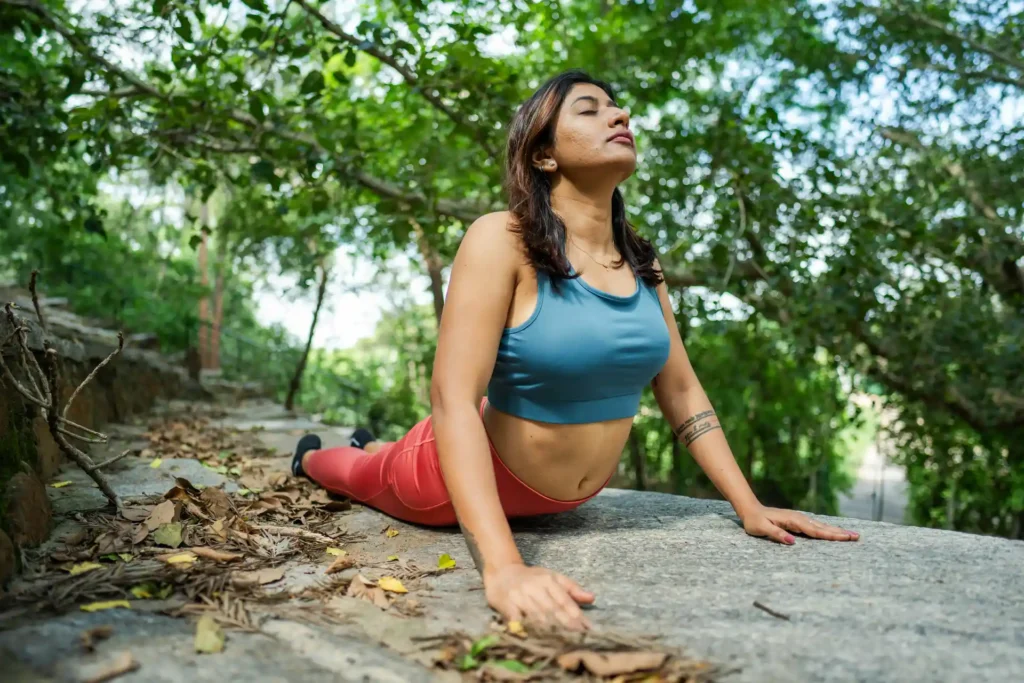
6. Abdominal Stretch

Muscles worked: Full abs and hip flexors
How to do
- Lie face down on the mat, stretch your legs straight back.
- Push your upper body up slowly while keeping hips grounded.
- Stretch your front body and feel a light stretch through your abs.
- Stay relaxed and let tight abs loosen gradually.
- Duration: 30 seconds
Tips
- Take slow deep breaths to relax tired core muscles.
- You should feel a light stretch through your abs.
- Do not bend backward too far to prevent waist pain.
- Relax your hips fully to get better stretching results.
Troubleshooting
If you feel sharp pressure in your lower back instead of a light stretch through your abs, you are probably pushing too high too soon. Lower your chest slightly and keep the stretch gentle.
10 Minute Bodyweight Ab Workout Routine for Beginners
This routine is built as a simple 10-minute bodyweight ab workout for people who want to train abs at home without equipment. Instead of counting reps, you will work by time, which makes the routine easier to follow and helps you stay focused on control.
Use the table below as your complete beginner abs workout plan. Move through each exercise in order, rest for 15–20 seconds between moves, and keep the pace slow enough that your abs stay engaged.
| Exercise | Duration |
|---|---|
| Elbow Plank Crunches | 30 sec |
| Upper Abs Crunches | 30 sec |
| Reverse Crunch | 30 sec |
| Side Plank Hip Dip | 30 sec / side |
| High Plank Crunches | 30 sec |
| Abdominal Stretch | 30 sec |
Rest between exercises: 15–20 seconds 2 rounds — Total time: ~10 minutes
For this at home bodyweight core workout, 2 rounds is enough if you are just starting out. If it feels too easy, resist the urge to move faster. Slow down each movement, pause briefly when your abs contract, or repeat the circuit one more time.
This pairs well with our Chest Workout at Home Without Equipment on alternate days.
How Often Should You Work Out Your Abs
Most beginners should train abs 2–3 times per week, with at least one rest day between sessions. Like any other muscle group, your abs still need time to recover, especially when you are doing slow, controlled bodyweight exercises instead of rushing through sloppy reps.
A common question is, “Can you do abs every day?” Technically, yes, but it is not the best starting point for most people. If your core is still sore, your lower back feels tight, or your hip flexors take over during ab exercises, daily ab training can make your form worse instead of better.
For a beginner ab workout, quality matters more than frequency. Two or three focused sessions per week are enough to build core control, improve stability, and help your abs recover between workouts.
If you are following this ab workout for beginners, start with 2 rounds per session. When the workout starts feeling easier, slow the reps down, pause longer during each contraction, or add a second round before increasing weekly frequency. This keeps the routine effective without piling on more work than your core can recover from.
Common Mistakes & Tips
Even a simple Bodyweight Workout for Abs can feel useless when the wrong muscles keep taking over. Most beginners do not need a harder routine right away. They need cleaner reps, better breathing, and a better sense of where the tension should be.
Mistake 1: Using momentum instead of your abs
This usually shows up when your legs start swinging, your hips bounce through the movement, or your lower back begins to arch. You may look like you are working hard, but your abs are not doing much of the work.
Slow the rep down. Make the movement smaller if needed. If you cannot squeeze your abs before you move, the range is probably too big. A slower rep that you can actually feel is more useful than a fast rep you barely control.
Mistake 2: Turning crunches into neck work
Upper ab crunches should not leave your neck sore. If your neck feels tight before your abs do, you are probably pulling your head forward or trying to sit up too high.
Keep your hands light behind your head. Think about curling your upper back off the floor, not dragging your chin toward your chest. The movement is smaller than most beginners expect.
Mistake 3: Letting your hip flexors take over lower-ab moves
Lower-ab moves often turn into hip-flexor work when you go too big or too fast. You might feel burning near the front of your hips, while your lower abs barely feel involved.
Reduce the lifting height first. Move slowly enough to keep your hips from tilting or swinging. If you need to swing to finish the rep, the range is probably too big for now.
Mistake 4: Holding your breath
A lot of people hold their breath during planks and crunches without noticing. That usually makes the body stiff, shaky, and harder to stabilize.
If you catch yourself holding your breath, reset before the next rep. Breath-holding usually means the movement is too rushed, too tense, or harder than your core can control cleanly.
Mistake 5: Jumping to advanced ab moves too early
Dragon flags, hanging leg raises, and long plank variations look impressive, but they are not the first step for most beginners. If your lower back, hips, or neck keep taking over on basic floor moves, advanced exercises will usually make the same problem worse.
A good model ab workout should help you build clean reps before chasing harder progressions. Start with simple floor-based movements, learn what your abs should feel like, and progress only when your form stays solid.
These same mistakes show up whether you are following a basic floor routine or moving toward a more dynamic cardio workout for abs. Fix the foundation first.
How to Make This Workout Harder
Once this Bodyweight Abs Workout feels easy, do not rush straight into harder ab moves. Make the same exercises more challenging first by working longer, resting less, slowing the tempo, or pairing movements with other no-equipment workouts.
1. Increase the work time
Start with 30 seconds per exercise. When you can keep good form for the full 45 seconds, move up to 45 seconds.
Only increase time if you can keep clean form. If your lower back starts arching or your hips start swinging, stay at 30 seconds for now.
2. Shorten your rest time
Begin with 15–20 seconds of rest between exercises. Later, reduce it to around 10 seconds.
This makes the routine harder without adding new exercises, which is useful if you want to keep this as a simple 10 minute bodyweight ab workout.
3. Add another round
2 rounds is enough when you are just starting out. After a few weeks, repeat the full circuit one more time.
Do not add a second round just to make the workout look harder. Add it when you can still feel your abs working clearly near the end of the circuit.
4. Move from static to dynamic versions
Static holds teach position. Dynamic moves test whether you can keep that position while your body moves.
For example, once a Side Plank Hip Dip feels stable, you can later try small hip dips. Once elbow plank crunches feel controlled, slow the movement down or pause briefly at the hardest point.
5. Pair abs with other no-equipment workouts
Your core supports almost every bodyweight movement, so this routine works well with other no-equipment training. As an equipment-free ab workout, it fits naturally into any training day without needing extra gear.
If you want more variety, a light cardio ab workout — like mixing mountain climbers into the circuit — is a natural next step. An ab cardio workout adds intensity without extra equipment once the floor-based moves feel easy.
If you need a lighter option on recovery days, some of these movements can also be adapted as an ab workout in bed on a firm surface — though floor training gives better stability for building control.
For more routines, browse the No Equipment training section.
When this beginner routine no longer feels challenging, move on to the Advanced Bodyweight Ab Workout guide.
Frequently Asked Questions
Is it better to work out abs fast or slow?
Slow is usually better, especially for beginners. Fast ab reps often turn into momentum, which means your hips, legs, or lower back may start doing the work instead of your abs.
If you want your bodyweight ab workout to feel more effective, focus on clean reps first. Move slowly enough to feel your abs tighten, control the return, and avoid swinging through the exercise.
Is 10 minutes of abs a day enough?
Yes, 10 minutes can be enough for one ab workout, but most beginners do not need to train abs every day. A focused abs workout in 10 minutes with slow reps and proper core tension is more useful than a longer session with poor form.
Start with 2–3 sessions per week. If your abs recover well and your form stays clean, you can add another short session later.
Can you build abs with bodyweight exercises?
Yes. Bodyweight exercises can build stronger abs when you use enough tension, control, and progression. You can make them harder by slowing the tempo, increasing work time, shortening rest, or adding another round.
Do not just chase more reps. If your legs swing, your lower back arches, or your hips take over, reduce the range and make the movement cleaner first.
If you want to pair this session with upper body training, our Beginner Arm Workout at Home Without Equipment fits well on the same day.
Conclusion
I used to skip ab training because I thought it required machines, weighted cables, or advanced moves. That changed when I tried a simple 10-minute session using nothing but the floor and my own bodyweight — and finally felt my abs working in a way I had not felt before.
The six exercises in this bodyweight ab workout are not complicated. What makes them work is the way you do them: slower reps, steady breathing, and enough control to make your abs do the work instead of your hips or lower back.
Start with one round today. Your floor, your bodyweight, and ten focused minutes are enough to begin.