
Fibularis Group Exercises at Home: 3 Moves for Outer Lower-Leg Strength
By Zephyr · Published Jul 17, 2026
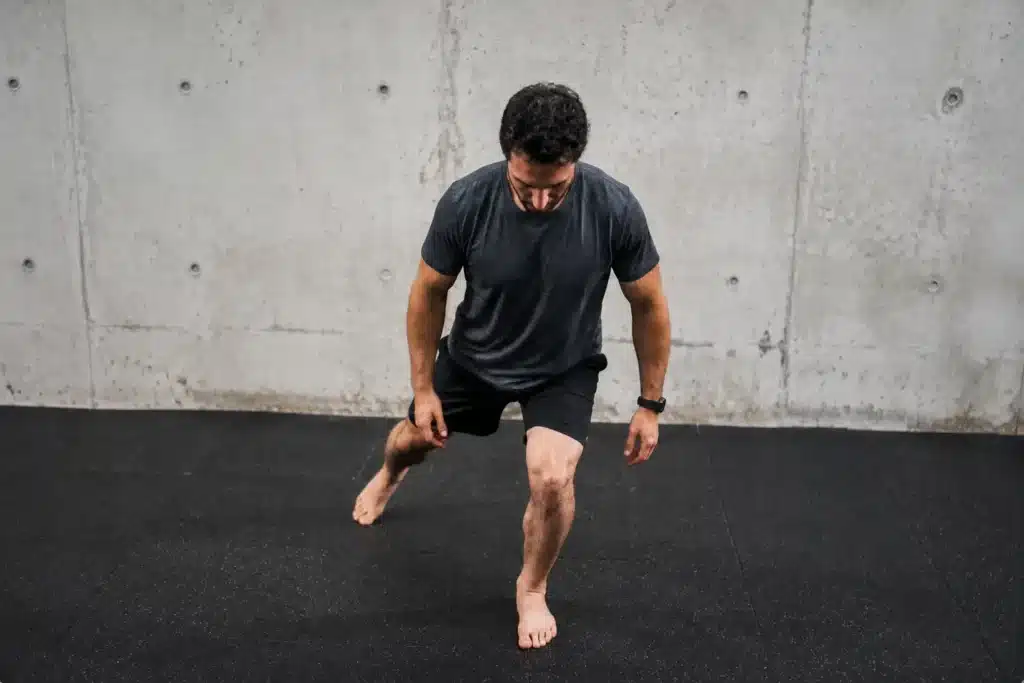
These fibularis group exercises train the muscles along the outside of your lower leg with a resistance band, an ankle weight and a controlled single-leg balance drill.
If you searched for a fibularis group exercise but kept finding medical pages about peroneal tendinitis, the naming is part of the problem. Fibularis is the current anatomical term, while peroneal is still widely used in exercise and clinical content. This article uses both terms, but the routine is for general strength training—not treatment for tendon pain, nerve symptoms or an ankle injury.
The main challenge is not finding a long list of movements. It is learning to move the foot outward without rotating the entire leg, then progressing beyond a light activation drill. This routine starts with direct ankle eversion, adds a different external-resistance setup and finishes with an integrated balance task.
Use it as a focused outer-lower-leg block within the complete lower-leg workout that combines all four movement directions.
Quick Summary
- The fibularis group runs along the outside of the lower leg.
- Fibularis and peroneal describe the same general muscle group.
- Ankle eversion—moving the sole outward—is the main direct training task used here.
- Keep the knee and hip still so the movement comes from the ankle.
- The routine combines band resistance, an ankle weight and single-leg control.
- This is a strength routine, not a treatment plan for persistent outer-ankle symptoms.
How Do You Strengthen the Fibularis Group?
Strengthen the fibularis group by combining ankle eversion with progressive resistance and single-leg control.
During direct eversion work, keep the lower leg still while moving the foot outward through a range you can repeat. A laboratory study comparing peroneus-longus activity during ankle tasks found greater activity in its posterior neuromuscular compartment during eversion than plantar flexion. This supports eversion as a direct training task, while longer-term strength or muscle changes still depend on progressive loading. See the laboratory comparison of peroneus-longus activity during eversion and plantar flexion.
The three exercises have different jobs:
- Seated band eversion establishes the movement.
- Side-lying ankle-weight eversion adds another measurable resistance option.
- A single-leg three-way reach applies lateral lower-leg control during balance.
Together, they provide a clearer progression than several nearly identical band variations.
Fibularis and Peroneal Explained
Fibularis and peroneal describe the same general muscle group along the outside of the lower leg. Fibularis is the current anatomical term, while peroneal and peroneus remain common in older exercise and clinical resources.
The group includes fibularis longus, brevis and tertius. Longus and brevis contribute mainly to ankle eversion and plantar flexion, while tertius assists eversion with dorsiflexion.
A cadaveric comparison of fibularis longus and brevis muscle structure found that fibularis longus had greater volume, longer fibres and a larger physiological cross-sectional area than fibularis brevis, while the difference in pennation angle was not significant. Because the study used a small sample of older specimens and did not test exercise techniques, it does not establish a special foot angle or movement for isolating either muscle. The practical takeaway is to train the group by function rather than chase anatomical isolation.
For practical fibularis exercises, training by task is more useful than trying to assign a separate movement to every muscle. Resisted eversion provides direct loading, while the three-way reach introduces a larger ankle-control challenge.
3 Fibularis Group Exercises for Outer Lower-Leg Strength
1. Seated Resistance-Band Ankle Eversion
Video: Sports Injury Clinic
Main Muscles Worked:
Fibularis group, with direct ankle-eversion emphasis
Role in the Workout:
I place this exercise first because the seated position makes it easier to learn ankle eversion without turning the knee or hip. Establish this movement before adding a less stable task.
How to Do It:
- Sit with the working leg extended or comfortably supported.
- Anchor a resistance band on the inside of the working foot so it pulls the forefoot inward.
- Loop the other end around the forefoot and begin with the ankle in a neutral position.
- Keep the knee and shin still as you move the sole of the foot outward.
- Pause briefly, then return slowly without letting the band snap the foot back.
How It Should Feel:
Look for tension along the outside of the lower leg. The thigh should remain quiet while the ankle produces the movement.
Practical Tip:
Use a light band until you can keep the kneecap pointing upward and the heel nearly stationary. A small ankle movement is more useful than a larger repetition created by rotating the entire leg.
An eight-week study using different resistance-band protocols reported increases in fibularis muscle cross-sectional area and ankle strength under the tested conditions. The findings support gradually loading band work, although the researchers did not test this exact exercise setup or promise complete muscular isolation. See the resistance-band study that measured changes in fibularis muscle size and ankle strength.
Troubleshooting:
- If the knee rolls outward, reduce the resistance and stabilize the thigh.
- If the band slips toward the toes, reposition it across the forefoot.
- If you mainly feel the front of the ankle, shorten the range and focus on moving the sole outward.
2. Side-Lying Ankle-Weight Eversion
Video: HomeCEU
Main Muscles Worked:
Fibularis group, with loaded outer-ankle movement emphasis
Role in the Workout:
This comes second because the side-lying position removes most of the balance requirement and changes how resistance reaches the ankle. It also gives you a simple load that can be recorded from session to session.
How to Do It:
- Lie on your side with the working leg on top and the lower leg supported.
- Secure a light ankle weight around the forefoot or shoe.
- Keep the knee and shin in place as you lift the outer edge of the foot.
- Pause at the top, then lower at a steady pace.
How It Should Feel:
The effort should remain along the outside of the lower leg rather than shifting into the hip.
Practical Tip:
Start lighter than you expect. Because the weight sits far from the ankle, a small load can create a meaningful challenge.
Troubleshooting:
- If the whole leg lifts, support the shin and use less weight.
- If the foot twists instead of lifting cleanly, reduce the range.
- If the weight shifts or presses uncomfortably on the foot, stop and adjust its position.
3. Single-Leg Balance with 3-Way Reach
Video: E3 Rehab Exercise Library
Main Muscles Worked:
Outer lower-leg and ankle stabilizers, with whole-leg balance emphasis
Role in the Workout:
The final drill asks the fibularis group to contribute during a larger single-leg task. Instead of isolating eversion, it challenges you to maintain foot and ankle position while the free leg moves.
Balance work complements progressively resisted eversion rather than replacing it. Its purpose here is to apply the strength and awareness developed in the first two exercises.
How to Do It:
- Stand on one leg with a soft knee and the whole foot in contact with the floor.
- Tap the free foot forward, then return to the center.
- Tap laterally, return again and finish with an inward or diagonal-behind tap.
- Keep most of your weight on the standing leg throughout the sequence.
- Complete each round before changing sides.
One round consists of a forward, lateral and inward or diagonal-behind tap.
How It Should Feel:
Expect small corrections around the standing ankle and lateral lower leg. The foot should stay grounded instead of suddenly rolling toward its outer edge.
Practical Tip:
Keep a wall or stable support within reach. Shorten the taps before allowing the standing foot or knee to lose position.
Research measuring peroneus-longus activity during different single-leg balance conditions supports using balance as an integrated ankle-control task. Because the researchers did not test this exact three-way reach, the study supports the exercise’s general role rather than proving isolation or a unique advantage. See the study comparing peroneus-longus activity across single-leg balance conditions.
Troubleshooting:
- If you repeatedly lose balance, use fingertip support and shorten every tap.
- If the knee collapses inward, reduce the distance and keep the kneecap aligned with the middle toes.
- If the outer ankle feels pinched or painful, stop rather than forcing a longer reach.
15-Minute Fibularis Group Workout at Home
Main Workout
| Exercise | Sets | Reps | Rest |
|---|---|---|---|
| Seated Resistance-Band Ankle Eversion | 2–3 | 12–15 each side | 30–45 sec |
| Side-Lying Ankle-Weight Eversion | 2–3 | 10–15 each side | 45–60 sec |
| Single-Leg Balance with 3-Way Reach | 2–3 | 3–5 rounds each side | 45–60 sec |
How to Use This Routine
Perform the exercises in order. Begin with direct eversion while you are fresh, introduce the ankle weight next and finish with the integrated balance drill.
Choose resistance that allows each repetition to look similar. End the set when the thigh begins to rotate, the band pulls the foot back abruptly or the reach becomes difficult to stabilize.
Add this focused block after the main compound exercises on a lower-body day. Most people do not need a separate session devoted entirely to peroneal exercises.
This is an outer-lower-leg block, not a complete lower-leg routine. You can combine it with the related front-of-shin work built around controlled dorsiflexion, the straight-knee training used to load the more visible upper-calf region or the bent-knee work that shifts more of the demand toward the deeper calf.
Safety: Stop if you experience sharp pain, increasing swelling, numbness, tingling, repeated ankle giving-way or discomfort that continues around the outside of the ankle. Those symptoms need appropriate assessment rather than additional repetitions.
Common Mistakes
Rotating the entire leg during eversion
Keep the knee and shin still. The foot should move at the ankle instead of being carried outward by the hip.Using too much band tension
Excessive resistance shortens the range and encourages whole-leg compensation. Choose a band you can manage in both directions.Letting the band pull the foot back
The return is part of the repetition. Slow it down instead of relaxing as soon as the foot reaches the outer position.Rolling onto the outside edge of the foot
Eversion training is not a cue to stand on the outer border of the foot. Keep pressure distributed across the standing foot during the three-way reach.Treating instability as the goal
The reach is useful only while the foot, ankle and knee remain organized. More wobbling does not automatically create better training.Judging the workout only by burning or soreness
Use repeatable movement, increasing resistance and improving reach quality as your progress markers.
Regressions and Progression Tips
Seated Resistance-Band Ankle Eversion
Use a lighter band or reduce the range for an easier version. Progress by adding a little band tension or holding the end position briefly.Side-Lying Ankle-Weight Eversion
Begin without external weight if necessary. Add load only when the shin stays in place throughout the set.Single-Leg Balance with 3-Way Reach
Start with hand support and shorter taps. Progress by reducing support, reaching farther or slowing the return. Change one variable at a time.
If one side is clearly weaker, train that side first and give the stronger side the same resistance and repetition target. Wait until the weaker ankle can reproduce the movement before increasing its load.
Record at least one variable: band resistance, ankle-weight load, usable range, reach distance or the number of clean rounds. Adding repetitions has limited value when movement quality declines.
Frequently Asked Questions
Can calf raises replace fibularis group exercises?
No. Calf raises primarily train plantar flexion, while the first two exercises directly load ankle eversion. The fibularis muscles may contribute to both tasks, but the training demands are different.
Can you isolate the fibularis muscles?
Complete isolation is unlikely. Resisted eversion can emphasize the fibularis group, while other lower-leg muscles continue to stabilize the ankle. The balance drill intentionally involves the group as part of a larger movement.
How often should I train the fibularis group?
Start with two sessions per week. Consider a third session only when recovery is comfortable and the work does not interfere with the rest of your lower-body training.
Why can’t I feel the outside of my lower leg working?
The resistance may be too heavy, or the knee and hip may be rotating with the foot. Use a lighter load, stabilize the shin and work through a smaller range that clearly comes from the ankle.
What is the difference between fibularis and peroneal?
They are different names for the same general muscle group. Fibularis is the current anatomical terminology; peroneal and peroneus remain common in older resources, clinical discussions and exercise searches.
Conclusion
Effective fibularis group training requires more than repeatedly moving a light band. The ankle must produce the eversion, the resistance must remain measurable and the movement quality must survive each progression.
Use seated band eversion to establish the motion, side-lying ankle-weight eversion to add another loading option and the three-way reach to carry that outer-lower-leg control into a single-leg task.
The goal is stronger, more repeatable ankle control—not a forced isolation sensation or the largest possible movement.
Medical disclaimer: This article is intended for educational and informational purposes only. It is not intended as a substitute for medical advice. For health advice, contact a licensed healthcare provider.