
Leg Exercises at Home: A Simple 5-Move Full-Leg Workout
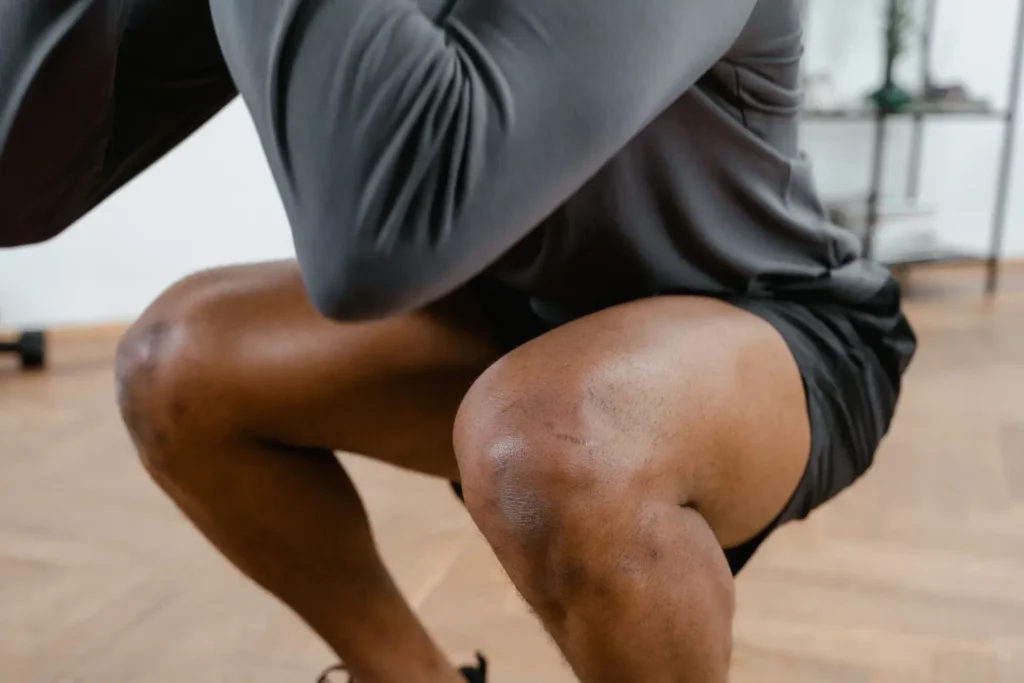
Leg exercises at home do not need to turn into a list of 15 or 20 movements. A useful leg workout only needs enough variety to train the thighs, glutes and lower legs without repeating the same task through several similar exercises.
This guide is part of a beginner-focused home-training system built around calisthenics, simple equipment and clear exercise progressions. The routine uses five movements: a bilateral squat, a supported single-leg exercise, a hip hinge, a calf raise and a tibialis raise.
This five-exercise leg workout routine takes about 20–30 minutes. You need floor space, a stable chair, a wall and an optional loaded backpack or dumbbell. It is intended for general strength training, not rehabilitation for pain or injury.
Quick answer:
Perform these exercises in order:
- Chair Squat or Bodyweight Squat
- Supported Split Squat
- Backpack Romanian Deadlift
- Standing Calf Raise
- Wall Tibialis Raise
Follow the table below for the exact volume. The Squat and Romanian Deadlift use two or three sets. The remaining movements begin with two sets. Choose versions that leave approximately two controlled repetitions available.
How to Train the Whole Leg Without a Long Exercise List
A complete beginner routine does not require a separate isolation exercise for every muscle. It needs a small number of movements with complementary roles.
| Training Area | Role in This Routine | Main Exercises |
|---|---|---|
| Thighs | Bilateral, unilateral and posterior-thigh work | Squat, Split Squat, Romanian Deadlift |
| Glutes | Hip extension and contribution to compound leg movements | Squat, Split Squat, Romanian Deadlift |
| Lower legs | Plantar flexion and dorsiflexion | Calf Raise, Tibialis Raise |
These areas overlap. Your glutes contribute to squatting, split-stance work and hip hinging. Your thighs also contribute to several movements involving the hips and knees.
In this guide, “full-leg” means that the routine covers the major regions and movement tasks needed for a general home workout. It does not mean that five exercises isolate every muscle or provide complete specialization for every goal.
When one region needs more direct attention, move to its focused Hub instead of adding every possible exercise to this session.
Five Leg Exercises for a Balanced Home Workout
1. Chair Squat or Bodyweight Squat
The Squat provides a stable bilateral knee-dominant movement. It trains your thighs while your hips and glutes help control the descent and return you to standing.
Stand in front of a stable chair with your feet approximately hip- to shoulder-width apart. Move your hips down and back, keep both feet planted and lower under control. Lightly touch or sit on the chair, then stand without bouncing off the seat.
Use a higher chair if you cannot control the descent. As the movement becomes easier, progress to a lower surface, a free-standing Bodyweight Squat or a securely loaded backpack.
Stop the set if you begin dropping onto the chair, shifting repeatedly toward one side or losing control of your knee and foot positions.
2. Supported Split Squat
The Supported Split Squat adds a unilateral knee-dominant task. It lets each leg work separately and makes repeated left-to-right differences easier to notice.
Stand in a split stance beside a wall, counter or stable chair. Use light hand support, keep the front foot planted and lower through a range you can control. Push through the front foot to return.
Using support is not cheating. It reduces the balance demand so that the working leg, rather than instability, determines when the set ends.
If the full movement is too difficult, use a shorter range or begin with a Sit-to-Stand. Record each side separately and let the less capable side set the repetition target.
Need more direct quadriceps or hamstring work? The focused guide below expands the thigh-training system without making this general routine longer.
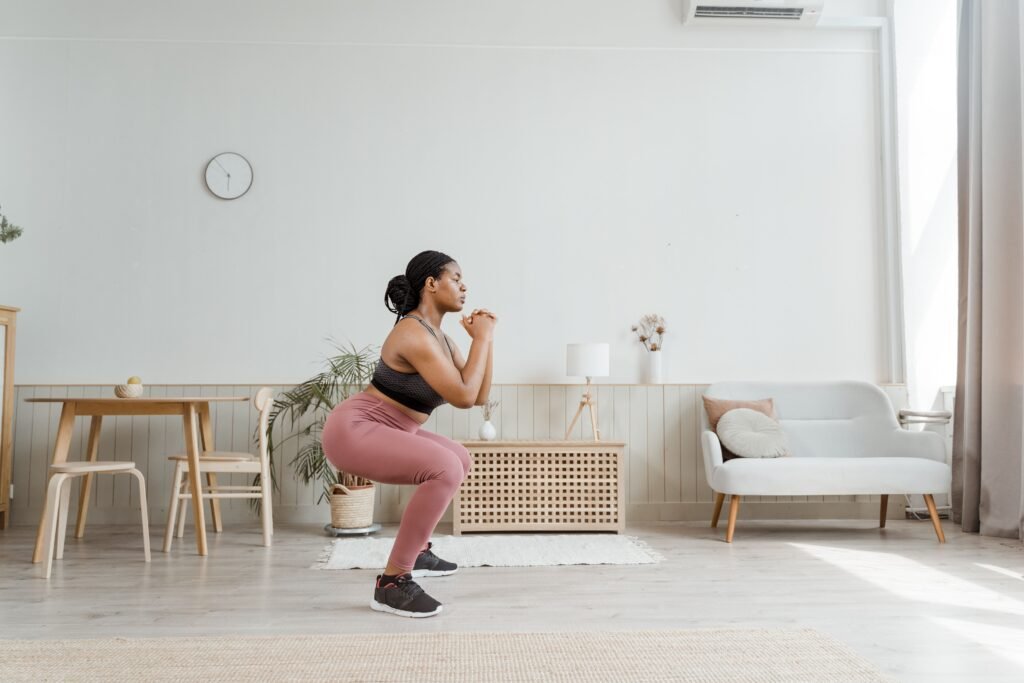
Train the front and back of your thighs with four home exercises, beginner options, a complete routine and clear progression rules.
3. Backpack Romanian Deadlift
The Backpack Romanian Deadlift supplies the hip-hinge task that a squat-only routine can miss. It places more deliberate emphasis on the posterior thigh while the glutes assist with hip extension.
Hold a securely closed backpack close to your body. Soften your knees, push your hips backward and allow your torso to incline. Lower only as far as you can maintain a controlled trunk position, then bring your hips forward to stand.
Begin with a Wall Hip Hinge if you are still learning the movement. Stand a short distance in front of a wall with your back facing it, push your hips backward until they lightly touch the wall, then return to standing.
Some glute involvement is normal. Reduce the load, shorten the range or return to the Wall Hip Hinge if your grip, lower back or balance repeatedly limits the movement before your posterior thigh. Stop if the exercise becomes squat-dominant or your back position changes.
In a six-week randomized trial comparing Romanian deadlift and Nordic hamstring training, 32 healthy young adults performed one of the two programs twice per week. Hamstring anatomical cross-sectional area increased after six weeks, with no significant difference between the groups. This supports the Romanian deadlift as a valid hamstring-loading pattern, but the study did not test a lightly loaded backpack version, complete beginners or this five-exercise routine.
If hip extension, lateral control or single-leg stability is your priority, continue with the focused glute guide below.
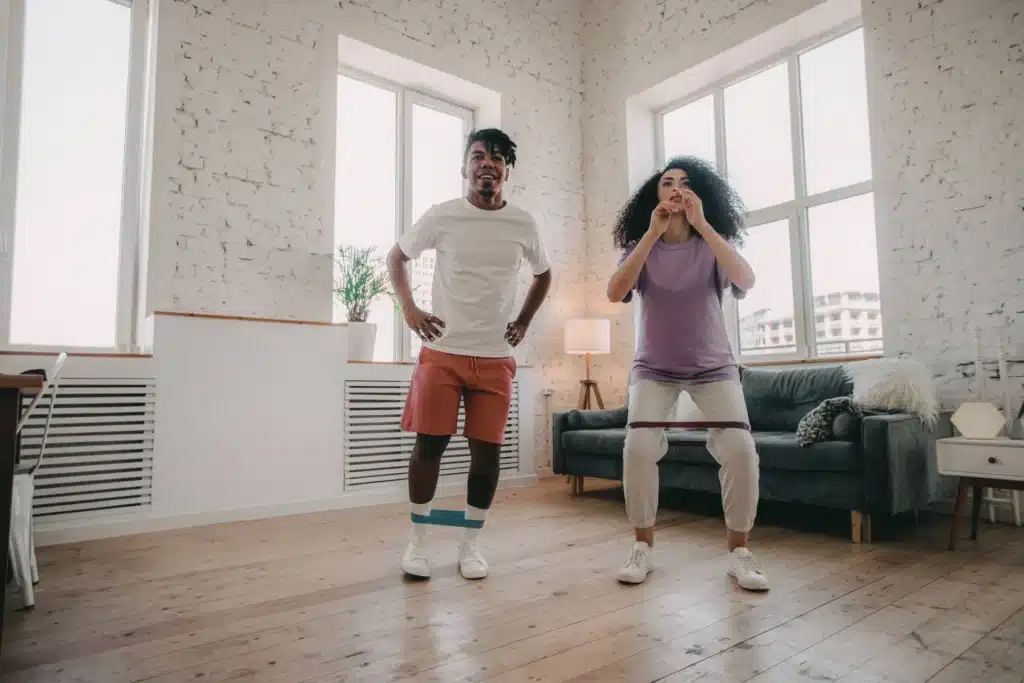
Try four glute exercises at home for beginners. Train hip extension, lateral control and single-leg stability with bodyweight and simple equipment.
4. Standing Calf Raise
The Standing Calf Raise supplies plantar-flexion work for the back of the lower leg.
Stand beside a wall, railing or stable chair. Keep your knees comfortably extended, raise your heels under control, pause briefly and lower without bouncing. Use two legs first so balance does not end the set before your calves have done meaningful work.
Progress by increasing the controlled range on a stable step, using one leg or adding a secure dumbbell or backpack.
Stop before the movement turns into a bounce, the range becomes noticeably shorter or your ankles repeatedly roll away from a stable position.
In a 12-week study, 14 untrained adults trained one leg with Standing Calf Raises and the other with Seated Calf Raises. Standing training produced greater growth across the measured gastrocnemius regions, while soleus growth did not differ significantly between the two conditions.
This makes the Standing Calf Raise a useful choice for the back of the lower leg. It does not mean that one standing variation trains the entire lower leg. See the 12-week study comparing muscle growth from Standing and Seated Calf Raises.
5. Wall Tibialis Raise
The Wall Tibialis Raise adds dorsiflexion—the action of bringing the forefoot toward the shin. It gives the routine a front-of-lower-leg task instead of treating calf raises as the whole lower-leg plan.
Stand with your back against a wall and place your feet slightly forward. Keep your heels planted, lift the whole forefoot toward your shins, pause and lower under control.
Move your feet closer to the wall to make the exercise easier. Move them farther away only while you can maintain the same heel-down, forefoot-up action without rocking your body.
Stop when only your toes lift, the usable range shortens or your body starts rocking to complete the repetition.
A cross-sectional study of 31 participants measured the tibialis anterior during graded isometric dorsiflexion. Its functional and architectural measurements were significantly associated with dorsiflexion torque.
This helps establish the tibialis anterior’s role in dorsiflexion. The study did not test Wall Tibialis Raises or measure long-term results from a home routine. See the repeated-measures study examining tibialis anterior behavior during graded isometric dorsiflexion.
The study did not test wall tibialis raises or measure long-term strength or muscle growth from this exercise.
For a dedicated session that also includes bent-knee calf work and controlled ankle eversion, continue with the focused lower-leg guide below.
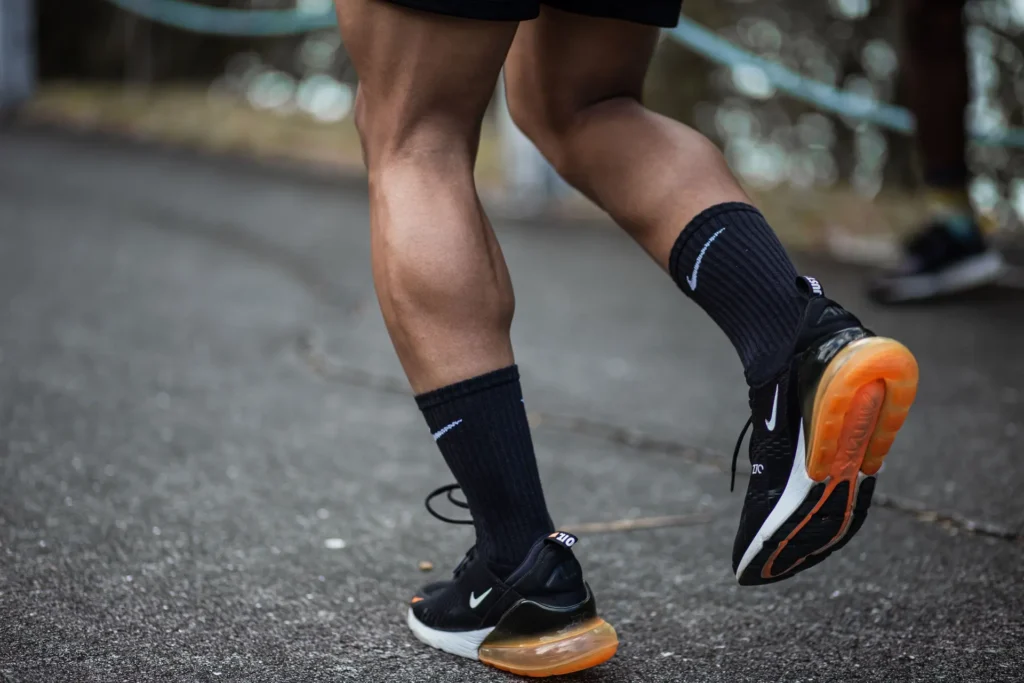
Train your calves, shins and outer lower legs at home with four exercises, clear progression rules and a complete 10–15-minute beginner routine.
20–30-Minute Leg Workout at Home
The base routine requires a wall, a stable chair and a securely closed backpack that can hold a manageable load. Dumbbells are optional, and resistance bands are not required.
If you want to avoid added weights entirely, use the separate collection of beginner workouts built around bodyweight exercises and no gym equipment. This page allows simple equipment because a backpack, chair or wall can make progression and balance control more practical.
Perform the exercises in the listed order.
| Exercise | Sets | Reps | Rest | Easier Option |
|---|---|---|---|---|
| Chair Squat or Bodyweight Squat | 2–3 | 8–12 | 60 sec | High Chair Sit-to-Stand |
| Supported Split Squat | 2 | 6–10 each side | 60–75 sec | Supported Partial-Range Split Squat |
| Backpack Romanian Deadlift | 2–3 | 8–12 | 60–75 sec | Wall Hip Hinge |
| Standing Calf Raise | 2 | 10–15 | 45–60 sec | Supported Two-Leg Floor Calf Raise |
| Wall Tibialis Raise | 2 | 12–20 | 45 sec | Stand Closer to the Wall |
Choose versions that leave approximately two controlled repetitions available. End a set when:
- the usable range becomes noticeably shorter;
- you can no longer control the repetition;
- you shift repeatedly toward one side;
- balance takes over from the intended movement;
- the exercise changes into a different movement pattern;
- discomfort is new, worsening or changes how you move.
The sequence is an editorial decision designed for practical beginner use. It has not been validated as a uniquely superior exercise order.
How to Progress Without Adding More Exercises
Do not respond to every plateau by adding another movement. First decide whether the current version is controlled and genuinely challenging.
Use this progression order:
- Establish a repeatable range.
- Control the lifting and lowering phases.
- Reach the top of the prescribed repetition range.
- Repeat that performance in two consecutive sessions.
- Increase one difficulty variable.
- Return to the lower end of the repetition range.
| Current Situation | First Adjustment |
|---|---|
| Your range is short but stable | Increase the controlled range gradually |
| Balance ends the set first | Use a wall or chair for support |
| The bodyweight version is too easy | Add a backpack, dumbbell or harder leverage |
| High repetitions make your breathing fail first | Add manageable resistance and return to a lower rep range |
| One side repeatedly performs less controlled work | Start with that side and record both sides separately |
Move to a harder version only when all prescribed sets reach the top of the range, the first and final repetitions look similar, approximately two controlled repetitions remain and you repeat the same standard in two sessions.
Change one main variable at a time. Record the exercise version, external load, controlled repetitions and any repeated left-to-right differences.
Minimum Session and Weekly Frequency
Twice per week is a practical starting frequency. Leave at least one day between demanding lower-body sessions and adjust for running, cycling, jumping, sport or other workouts that contain substantial squatting and hinging.
If you want to place this leg workout inside a complete first month of full-body training, use a structured 30-day beginner plan that coordinates leg exercises with pushing, pulling, core work and recovery days. Follow that plan’s weekly structure instead of adding unrelated sessions around it.
When a full workout is not realistic, perform:
| Exercise | Sets | Reps |
|---|---|---|
| Chair Squat | 2 | 8–12 |
| Backpack Romanian Deadlift | 2 | 8–12 |
| Standing Calf Raise | 2 | 10–15 |
This preserves a knee-dominant movement, a hip hinge and basic lower-leg work. It is a shortened option, not a complete replacement for the five-movement routine.
When to Train, Reduce, Recover or Stop
| Decision | When It Fits | What To Do |
|---|---|---|
| Train | Readiness is normal with no new movement-altering discomfort | Perform the planned workout |
| Reduce | Fatigue is unusually high or control is poorer | Remove one set, use an easier version or reduce the load |
| Recover | General fatigue makes controlled strength work unproductive | Choose comfortable walking or easy mobility |
| Stop | Sharp pain, swelling, instability, loss of function or worsening symptoms | Stop and seek qualified medical guidance |
This table is not a diagnostic tool. General muscular fatigue and ordinary delayed soreness are different from new, worsening or movement-altering pain.
Frequently Asked Questions
How Many Leg Exercises Should I Do per Workout?
Five complementary movements are a practical starting point for a general home workout. Adding several similar Squat, Lunge or Deadlift variations does not automatically make the session more complete.
Are Squats Enough for a Complete Leg Workout?
Squats train several thigh and hip muscles, but they do not replace every lower-body task. This routine adds a unilateral movement, hip hinge, calf raise and tibialis raise instead of relying on several Squat variations.
Can You Build Stronger Legs at Home?
Home exercises can become harder through range, tempo, pauses, unilateral work and external load from a backpack or dumbbell. Record the version, load and controlled repetitions so you can distinguish progression from simply doing more hurried reps.
Is Walking or Cycling Enough to Replace Leg Strength Training?
Walking and cycling provide useful movement and endurance work, but they do not automatically provide the same resistance, range or effort as deliberate strength training.
They can remain part of an active week while this routine provides a measurable way to increase lower-body strength demands.
Build a Simple Full-Leg Routine
A complete home leg workout does not need an exercise for every individual muscle. It needs enough complementary tasks to cover the thighs, glutes and lower legs without turning one session into an exercise catalogue.
Begin with the five movements and progress only when your range and control remain stable. When one lower-body region becomes the priority, continue into its focused Hub instead of making the general routine longer.
To balance this session with the rest of the body, use a home upper-body training framework that organizes pushing, pulling, shoulder and arm work with simple equipment.
Medical disclaimer: This article is intended for educational and informational purposes only. It is not intended as a substitute for medical advice. For health advice, contact a licensed healthcare provider.