
Bicep Exercises at Home: Stop Letting Forearms Take Over
By Zephyr · Published Jun 24, 2026
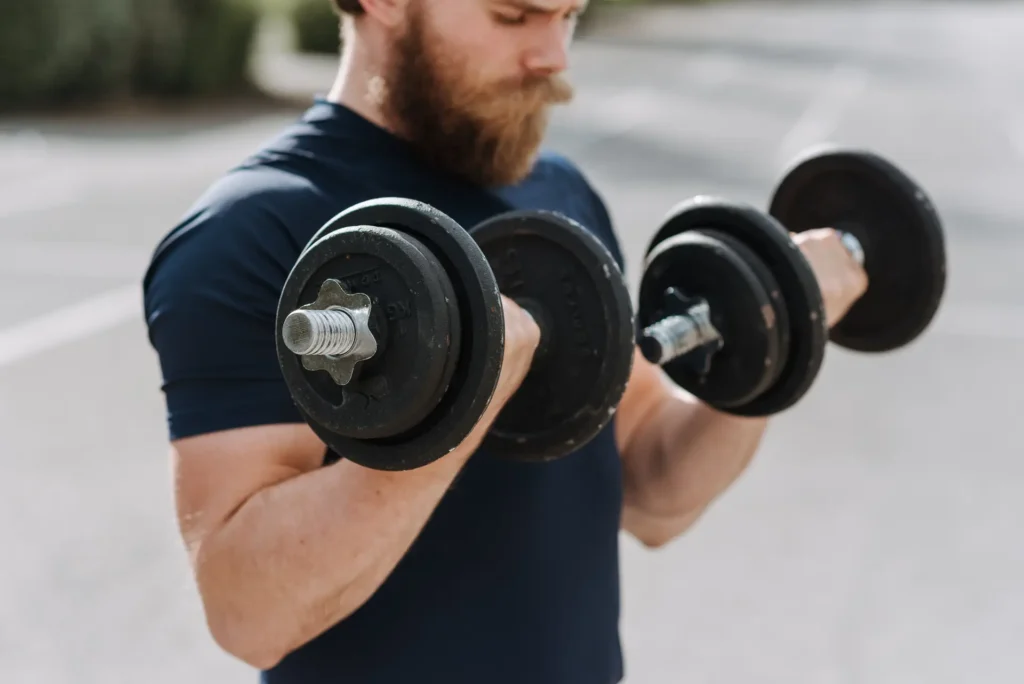
These bicep exercises use three home-friendly dumbbell moves: Standing Dumbbell Curl, Seated Alternating Dumbbell Bicep Curl, and Hammer Curl.
Do 2–3 sets of 8–15 reps, rest 45–60 seconds, and use a weight you can curl without swinging, shrugging, or turning the set into forearm work.
Most bicep exercises look simple: pick up a dumbbell, bend your elbow, and squeeze. The problem is that a curl can stop being a biceps exercise very quickly if the forearms grip too hard, the shoulders roll forward, or the weight starts moving because the body swings.
Curls are still worth doing. I would rather use three curl variations you can actually control than a long list of arm moves you cannot feel. This guide uses one standing curl, one seated curl, and one hammer curl so you can load the biceps, clean up the path, and build a simple routine without turning every set into a momentum test.
If you also want a broader arm session with no equipment options, pair this later with a beginner-friendly arm workout at home without equipment. For this article, the focus stays narrower: better curls, clearer tension, and a biceps routine you can repeat.
Quick Summary
These biceps exercises work best when each curl has a clear job.
- Standing Dumbbell Curl: the main loadable curl.
- Seated Alternating Dumbbell Bicep Curl: the control version that limits swinging.
- Hammer Curl: the neutral-grip curl for brachialis and forearm-side support.
- Start with clean reps before chasing heavier dumbbells.
- Bodyweight bicep exercises can help, but dumbbells are easier to measure and progress.
The goal is not to collect more curl variations. It is to make the same few curls easier to feel, measure, and progress.
What Exercises Work on Your Biceps?
A good bicep exercise should make elbow flexion the main task: the forearm moves toward the upper arm while the upper arm stays mostly still. Supination also matters because the biceps help turn the palm upward, which is why some curl variations feel more direct than others.
That is why exercises for biceps do not need to be complicated. A standing curl gives you load, a seated curl gives you control, and a hammer curl adds neutral-grip work for the brachialis and brachioradialis.
If your goal is broader arm development, elbow extension work for the triceps belongs in a separate routine. This article stays focused on elbow flexion and the muscles that drive it.
Research comparing different biceps curl handgrips found that grip position changes biceps brachii and brachioradialis excitation. That supports using both a supinated curl and a neutral-grip hammer curl instead of treating every curl as the same exercise. Study on grip position during biceps curl exercise
The 3 Best Bicep Exercises at Home
The best bicep exercises for this article are not the fanciest ones. Good bicep exercises should keep the upper arm quiet, give you a clear curl path, and let you progress without turning the rep into a swing.
These bicep exercises with dumbbells cover the main jobs most home lifters need.
1. Standing Dumbbell Curl
Video: Fit Father Project – Fitness For Busy Fathers
Main Muscles Worked:
- Biceps brachii
- Brachialis
How to do it:
- Stand tall with a dumbbell in each hand.
- Keep your elbows close to your sides.
- Start with your arms straight, but do not relax at the bottom.
- Curl the dumbbells by bending your elbows.
- Keep your upper arms mostly still.
- Squeeze near the top, then lower slowly.
Practical Tips:
- Keep your ribs down and avoid leaning back.
- Do not swing the dumbbells with your hips.
- Use a weight you can lift without your shoulders rolling forward.
How it should feel:
You should feel the front of your upper arms doing most of the work, not your lower back or shoulders.
Troubleshooting:
- If your shoulders move first, reduce the weight.
- If your forearms take over, loosen your grip slightly and keep your wrists neutral.
- If you swing every rep, pause briefly at the bottom before curling again.
Role in the Workout:
This is the main strength curl. Among dumbbell bicep exercises, it is the easiest one to load, track, and repeat.
A study comparing curl variations found that changes in grip and curl setup can alter biceps brachii and brachioradialis activity. This supports using the standing curl as the basic loading pattern, while using other curls for different roles. Study on muscle activity during biceps curl variations
2. Seated Alternating Dumbbell Bicep Curl
Video: OracleFitness
Main Muscles Worked:
- Biceps brachii
- Brachialis
How to do it:
- Sit upright with your feet flat on the floor.
- Hold a dumbbell in each hand.
- Curl one dumbbell while the other arm stays still.
- Keep your torso quiet and avoid twisting.
- Squeeze near the top.
- Lower with control, then switch sides.
Practical Tips:
- Use less weight than your standing curl.
- Start with your weaker side if one arm lags behind.
- Keep the elbow close to your body without pinning it aggressively.
- In most sessions I coach, the seated version immediately reveals whether the standing weight was being controlled or just moved.
How it should feel:
This should feel cleaner and stricter than the standing curl, with less help from the body.
Troubleshooting:
- If your torso twists, lower the weight.
- If your elbow drifts far forward, slow the curl down.
- If one side is weaker, match the stronger side to the weaker side’s reps.
Role in the Workout:
This is the control curl. It keeps the movement honest after the heavier standing curl.
3. Hammer Curl
Video: Buff Dudes Workouts
Main Muscles Worked:
- Brachialis
- Brachioradialis
How to do it:
- Stand or sit with a dumbbell in each hand.
- Hold the dumbbells with a neutral grip.
- Keep your elbows close to your sides.
- Curl without rotating your wrists.
- Stop near the top without shrugging.
- Lower slowly.
Practical Tips:
- Keep the thumbs pointing upward.
- Do not turn it into a regular curl at the top.
- Use a controlled tempo instead of bouncing the weight.
How it should feel:
You should feel the outer upper arm and upper forearm working, with the biceps assisting.
Troubleshooting:
- If your wrists bend, use lighter dumbbells.
- If your shoulders lift, stop the set earlier.
- If the dumbbells swing, slow down the lowering phase.
Role in the Workout:
This adds neutral-grip strength and arm thickness without needing another regular curl.
15-Minute Bicep Workout at Home
Two-Minute Preparation
- Arm circles: 30 seconds each direction
- Light dumbbell curls: 12 slow reps
- Light hammer curls: 10 reps
- Wrist circles: 30 seconds
Main Workout
| Exercise | Sets | Reps | Rest | Time |
|---|---|---|---|---|
| Standing Dumbbell Curl | 3 | 8–12 | 60 sec | 5 min |
| Seated Alternating Dumbbell Bicep Curl | 2–3 | 8–12 per side | 45–60 sec | 5–6 min |
| Hammer Curl | 2–3 | 10–15 | 45 sec | 4–5 min |
How to Use This Routine
Use this routine 1–2 times per week after your upper-body or arm training. If your biceps are a weak point, place it after your main pulling work, not after a session where your grip and forearms are already exhausted.
For bicep workouts at home, keep the plan simple enough that you can repeat it weekly. If the weight is light, use slower lowering, a brief pause near the top, and cleaner reps before adding more sets.
This is still a focused bicep workout, not a full arm day. If you want a broader structure for your week, place it inside a broader upper-body training plan built around simple equipment.
Safety Tips: Keep all reps controlled and pain-free. If you feel sharp elbow pain, numbness, or tendon pain that gets worse as the set continues, stop the exercise. This routine is for general strength training, not injury treatment.
Common Mistakes That Stop Your Biceps From Doing the Work
1. Letting Forearms Take Over
Forearm tension is normal, but forearms should not be the limiting factor on every curl. If your grip crushes the dumbbell, your wrist bends, or the weight pulls your hand out of position, the curl can become more about holding the dumbbell than training the biceps.
Use a firm but not maximal grip. Keep your wrist stacked, curl smoothly, and choose a weight that lets your upper arm stay quiet.
2. Swinging the Dumbbells Up
A small amount of body tension is fine. A hip swing is not. If the dumbbell jumps through the hardest part of the rep, your biceps miss the work they need most.
Lower the weight, pause at the bottom, and start each rep from stillness.
3. Letting the Shoulders Roll Forward
When the shoulders roll forward, the curl often turns into a shoulder-and-arm movement instead of a cleaner elbow-flexion drill.
Keep your chest relaxed but lifted, elbows near your sides, and shoulders quiet. You do not need to pin your shoulder blades hard; you just need to stop the shoulders from chasing the dumbbells.
4. Treating Bodyweight Bicep Exercises Like a Perfect Replacement
Bodyweight bicep exercises can help if you use chin-ups, ring curls, or towel curls. The limitation is progression. It is harder to make small, measurable jumps than it is with dumbbells.
Use bodyweight work as a useful option, not as proof that dumbbells are unnecessary.
Progression Tips for Growing Biceps With Light Dumbbells
If your dumbbells feel too light, do not immediately add random exercises. Make the current curls harder to execute well.
Try this order:
- Add reps until you reach the top of the range.
- Slow the lowering phase to 3 seconds.
- Pause briefly near the top.
- Use the seated version to reduce cheating.
- Add weight only when the curl path stays clean.
A study on elbow-flexor training found that training at a more flexed elbow range produced meaningful biceps growth, which supports the idea that controlled curl position and tension can matter even before load gets heavy. It does not mean partial reps should replace full reps, but it does support using pauses and controlled ranges as progression tools. Study on elbow-flexor range and biceps hypertrophy
Frequently Asked Questions
What Is the Most Effective Bicep Workout?
The most effective bicep workout is one you can repeat and progress. For most home lifters, that means one heavier curl, one stricter curl, and one neutral-grip curl.
You do not need ten variations. You need enough quality work that your biceps, not your hips, shoulders, or forearms, become the limiting factor.
Should I Do 3 or 4 Bicep Exercises?
Most beginners and intermediate home lifters only need 2–3 bicep exercises in one session. Add a fourth only if you can still control the reps and recover well.
If your curls already break down by the second exercise, adding more work usually makes the session worse.
Can You Build Biceps With Bodyweight Exercises?
Yes, but it is less convenient. Chin-ups, ring curls, and towel curls can train the biceps, but they are harder to adjust in small steps.
If your goal is simple home progress, dumbbells make the process easier to measure.
How Many Bicep Exercises Should I Do?
For this routine, three is enough: Standing Dumbbell Curl, Seated Alternating Dumbbell Bicep Curl, and Hammer Curl.
If you train biceps twice per week, you can repeat the same routine or reduce the sets slightly on the second day.
Do I Need Separate Long-Head and Short-Head Bicep Exercises?
Not at first. Grip, elbow position, and shoulder position can shift emphasis, but beginners usually get more from cleaner curls than from trying to split every biceps head.
Long-head and short-head training can become a future focus once your basic curl mechanics and progression are solid.
What Builds Biceps Fast?
Nothing builds biceps instantly. Faster progress usually comes from consistent training, enough weekly volume, clean reps, and small increases in reps or load.
If your form changes every session, your progress becomes harder to measure.
Conclusion
Biceps do not need a huge menu of curls. They need a curl path you can repeat, enough resistance to challenge the target muscle, and progression that does not turn the set into a swing.
I would progress this workout only when the biceps still feel like the limiting muscle. Add reps first, then slow the lowering, then add a little weight. If your forearms, shoulders, or lower back take over, the exercise got harder in the wrong way.
Use this routine in your next upper-body or arm session, record the dumbbell weight and reps you can control, and improve one variable without losing the curl feeling.
Medical disclaimer: This article is intended for educational and informational purposes only. It is not intended as a substitute for medical advice. For health advice, contact a licensed healthcare provider.